
Where Are With At With Climate Science?
Professor Hamish McGowan
Transcript
David Curnow
Hello, welcome to Where Are We At With? I'm David Curnow.
Thunderbolts and lightning very, very frightening to me and most of the sane world, especially given that the outcome of climate change is likely to see more frequent and intense storms as well as droughts and floods.
Every day people the world over check their local weather forecast for an idea of what the short-term conditions are likely to be. Yet many of them still seem to treat those forecasts, and by extension the forecasters, with a degree of scepticism. Sometimes even contempt. Even a stopped clock is right twice a day, scoffs some folk, when the 25 to 50 percent chance of at least 2 millimetres of rain turns into no rain. Or perhaps it turns into a storm, bringing 20 millimetres. Forecasters and meteorologists all rely on the centuries of observations and predictions that came before. When this readout is low, there's often a storm. When that readout's high, well, sunshine. Data is now exponentially greater in both volume and distribution. And using it are not just human brains, but computers with learning artificial intelligence that are trying to predict what even a tiny change might do to the weather across the entire planet. Can the flap of a butterfly's wings cause a tornado? Professor Hamish McGowan is a geographer and professor of atmospheric and climate sciences. He leads the Weather and Climate Science Research Alliance at the University of Queensland. For more than 30 years he's studied climate dynamics, meteorological hazards, archaeological evidence of climate patterns and how they might repeat, as well as subjects like how atmospheric interactions can affect the Earth's surface. The possibility of predicting not just the size of hail but where it will land, as well as what areas are more prone to lightning, and how to improve food security in a rapidly changing climate. In this episode, where are we at with climate science with Professor Hamish McGowan.
David Curnow (02:11)
Professor Hamish McGowan, thanks very much for joining me today.
Hamish McGowan (02:15)
You're welcome.
David Curnow (02:16)
Now, to start with, we need to be very clear. You're not a meteorologist or a forecaster. You're just the bloke that makes those people look good.
Hamish McGowan (02:24)
Well, that's one way putting it. No, I'm not a forecaster. Forecasting is not an area that I work in. However, the research that I undertake seeks to develop a better understanding of how the atmosphere works and how it interacts with the Earth's surface. Using that knowledge and that understanding, that feeds into our ability to improve projections or simulations of the future state of the climate and the atmosphere.
David Curnow (02:58)
Okay, let's talk about the challenge of both observing, ⁓ predicting, but also understanding the past when it comes to weather and climate. Most people have heard of the butterfly effect, the idea that the flap of the wing of a butterfly somewhere could weeks, months later affect the trajectory of something as big as a tornado. Now it's poetic hyperbole when it was introduced, but it's not ridiculously far from the truth, just how complicated is the weather and our climate?
Hamish McGowan (03:29)
Well, the weather is inherently very complicated, and we're making it more so by changing the composition of the atmosphere and changing the Earth's surface. They all have effects on how the atmosphere responds to those forcings, whether it be loading the atmosphere full of carbon or increasing the concentrations of carbon in the atmosphere and modifying the energy balance of the Earth's system ⁓ and therefore disrupting a system which inherently tries to maintain some form of dynamic equilibrium, a system that's trying to ensure regions don't overheat and other regions don't get progressively colder and colder. So, you know, there is an interplay between those forces that we're putting on the atmosphere and the natural dynamics of the atmosphere and how it interacts with a natural Earth system, the oceans, the land surface, and so forth. In terms of trying to predict the future weather at short time scales, like short lead times of hours to several days, overall we do a pretty good job. Somewhere around 90 % plus of our forecasts out to several days are reasonably accurate and meet those expectations of society as to whether I plan to do the washing this afternoon or tomorrow or maybe in a week's time or whether I plant the lawn with some fresh grass today or I leave it until it rains in the spring. So overall we're doing pretty well. As we move further out with our projections, then we start to become more uncertain and that sort of stems back to your comment about some form of disturbance which we are not accounting for, which the numerical models can't account for accurately. Trying to predict a tornado in six months' time is never going to happen. ⁓ Predicting the fact that the climate in six months' time might be conducive to severe storms that may then produce tornadoes? Yes, we're in that ballpark.
David Curnow (05:48)
It's interesting you mentioned that the idea of all those different factors because of course it was a climate model or a meteorologist initially who came up with the concept of butterfly effect talking about just how tiny changes in his models made radical differences in the outcomes of them. And you also mentioned the idea of us planning to hang the washing out maybe or what time we're picking the kids up from school, whether they can catch the bus or I'll pick them up. We tend to think of weather and climate in those terms generally as individuals but in a broad sense, we look at history, humanity essentially came about because climate changed and became the way it was.
Hamish McGowan (06:27)
Well, yes, I mean we had to have a climate system that was conducive to the evolution of life. And we're product of that evolutionary process ⁓ over millions, tens of millions, hundreds of millions of years. So yes, the climate system had to be conducive to ⁓ produce an environment which is conducive for our existence.
David Curnow (06:53)
And then I think ⁓ entering the Holocene entering the more recent period of interglaciation, effectively that period of relative stability allowed a sudden flourish in this two-legged species.
Hamish McGowan (07:06)
Yeah, I wouldn't say the climate system. I suppose when you talk about stability in a climate system, you need to think about what that means in terms of the context of time. You know, we know that today's weather is not going to be the same as tomorrow's, or probably in the next hour it's going to be different than what it is now. So there is inherent variability in the climate system and the weather that we experience. Certainly as we move, you know, over longer periods of time, there are distinct phases in the Earth's climate that have seen us move into periods which are warm. You know, for example, medieval warm period where you had wine being produced in the UK, you know, in Britain at the time, which supposedly was reasonably good. ⁓ And then you move into the Little Ice Age you know, in the 1600s, 1700s, 1800s global temperature actually cooled and you had, for example, sleighs being used to transport the royals from the mouth of the Thames into central London. So there is that variability and most of your listeners will be familiar with variability associated with El Nino and the Southern Oscillation. You know, we move into periods in Australia here where we have an El Nino every three to perhaps seven years and we have reduction in rainfall in these half of the continent becomes very dry, we have an explosion and bushfire occurrence and so forth and then we swing into La Nina periods ⁓ and it becomes almost the opposite, we do, and we see more cyclones and so forth.
David Curnow (08:49)
Given your work looking at climate and the modelling surrounding it and taking all the different, I suppose, data readings and things like that, the last thousands of years, however, most of that is just people knowing that at this time of year, this is when things should happen and observing through nature, in a sense, wasn't it? How accurate could they be? And were they actually relatively close?
Hamish McGowan (09:12)
Well I think, you know, people become very aware and conscious of the environment in which they live and when you're depending on it for your existence and the existence of the ones around you who you have responsibility for, then you are conscious of changes. Whether that be changes in the occurrence of fish species at the coast where you can collect fish, whether it be changes in the flowering of plants or fruits and so forth, you build into your society that consciousness. And it's really, I suppose, an environmental determinism that entrenches itself into societies and really what you're referring to there are societies, you know, hundreds, thousands of years ago.
David Curnow (10:09)
Given the techniques that you employ now, what technologies have made the biggest difference, say, over the past 100 years or so?
Hamish McGowan (10:17)
Without question, you know, the development of computers, the ability to simulate an incredibly complex system like the atmospheric environment and how it changes in response to different forcings and different characteristics of the oceans, the land, the ice sheets and so forth. And that has seen our ability to predict weather improve markedly than from getting a report from Joe Bloggs via telegraph that they had severe storms 200 kilometres away and who knows when it may arrive at your location. Same with severe flooding events, the ability of, or the advances in computational science has really driven the advances in forecasting.
David Curnow (11:13)
And using those computer models and using the ability to input a lot of data? Is it volume that matters? Is it the more satellite images, the more weather stations, the more observations you have, the better you can make the data?
Hamish McGowan (11:27)
Well, I suppose up to a point. I suppose, you know, certainly up until recently, you know, the ability to have very accurate information on the state of the atmosphere and how it's changing at the highest possible observational resolution you can get and put that information or ingest that information into forecasts enables more accurate prediction of how things are going to be in the future. I think where forecasting is heading with machine learning and artificial intelligence to some degree may supersede the need for such high resolution observations where you have the capability of self-learning and forecasts that are able to train themselves on historical data and build in patterns of weather in a pre-existing atmospheric state is likely to lead to much more accurate forecasts at that time frames of minutes to perhaps 10 days of fortnight than what we have at present and I think that's going to be really exciting. That's really a game changer.
David Curnow (12:43)
As long as they're positive, as long as it's not a case of, no, sure, David, you go out today, there's not going to be a large hailstorm at all.
Hamish McGowan (12:49)
Yeah well, as you said, maybe there's been a butterfly flapped its wings somewhere.
David Curnow (12:58)
Professor Hamish McGowan is my guest. He's a geographer and professor of atmospheric and climate sciences. He's based at the University of Queensland. Quite obviously those who know their accents know that's not originally where he's from. He came from an even more climactic enjoyable part of the world. Let's talk about the thermohaline circulation, the oceans. When do we become aware that what's under the surface affects what's above the surface, so to speak?
Hamish McGowan (13:22)
Well, think some of the early observations showed that changes in ocean behavior influence climate. People have always observed how changes in an ocean might influence the availability of marine resources, but also the influence of changes in ocean on weather, where increased storminess and so forth. In terms of the thermohaline circulation, you know, we've understood that circulation between our major ocean basins for a number of decades. I suppose what we're seeing now is a deepening of that understanding with improved observations of what's happening in the oceans through deployment of sensors and drifting buoys and buoys and sondes deep within the ocean, but also our ability to model the impact of that circulation on our climate and importantly to model what happens if that fundamentally important ocean circulation starts to change its behaviour.
David Curnow (14:41)
I know that's some of the work that you have done in the past. When we look at some of the circulation systems that we give names to, the Gulf Stream for instance, in the Atlantic, we in Australia tend not to think that that would have much effect on us, but suggestions are that it absolutely could.
Hamish McGowan (14:57)
Yes, well certainly, I suppose over the last 10 to 15 years, we've developed a better understanding of how our climate system connects from one region to another. And this is through the process of teleconnections. So how, for example, changes in central Atlantic circulation and sea surface temperature can influence what happens in the Pacific basin and that form of tele-connection, connecting a physical process that influences our climate from one region to thousands of kilometres in another region, has been known for some time. If we look at Sandy Troop and his development of the Southern Oscillation Index, let's look at simple correlations between discharges in the Ganges and sea surface temperature in the Pacific and rainfall patterns in Australia. We see that some of these patterns have a correlation, they seem to be associated. And from those sort of initial understandings we've developed a very good appreciation of this interconnectivity of weather, the atmosphere and the oceans.
David Curnow (16:15)
Again, looking at some of your work, it's interesting that it's not just about effectively trying to model what will happen, but understanding what has happened to assist in that modelling. How does examining observations from, say, Australia for 6,000 10,000 years ago help looking forwards?
Hamish McGowan (16:35)
Well, suppose there's several things to that question. ⁓ We look back into time in our geologic archives, whether it be ice cores, ⁓ lake sediments, marine sediments, peat deposits, tree rings and the like, to develop our understanding of how climate has naturally changed. What are the natural rhythms of the climate system we should expect? That's important, for example, understanding how climate variability might have impacted migrations of people across the earth. ⁓ It's also important to have that really solid, robust benchmark information to then understand, for example, how we're impacting climate, how much of the changes that we're experiencing are outside the boundaries of what we should expect a natural climate system to behave like and for example, that's why there's been major investments and programs over many decades to retrieve ice cores from both Greenland and the Antarctic. We know, for example, that climate change at the moment is happening, or the increase in temperature is happening, around 200 times faster than anything in the last million years. And that information comes from that understanding of deep time and climate variability.
David Curnow (18:10)
There weren't a lot of people writing it down on a chart on the fridge those times. How do you tell what the temperature was when you're literally looking at a piece of ice?
Hamish McGowan (18:23)
That's where computational science has been very handy. ⁓ You can date. You can date ice. You can date it. You can use different techniques, sometimes radiocarbon dating. Sometimes you can just go through and count the layers that have been accumulated on an annual basis and then when you get the ice core, you take it to a controlled laboratory, cool room environment, and you slice it ⁓ a bit like a, I suppose, a dog roll or something. ⁓ You slice it in very fine detail, and then you actually extract the air bubbles that are contained within the ice and you analyse those and you can get for example the concentration of CO2 in the atmosphere 552,000 years ago. ⁓ And you do that and you can extract other information from for example stable isotopes of oxygen that you can use to reconstruct and deuterium which you can use to reconstruct temperature. They're proxy. They give us an indication of what it was like.
David Curnow (19:37)
And is the same the case for places, say, in the Kimberley or land places at the moment where there isn't ice?
Hamish McGowan (19:44)
That's a bit more challenging. We've been working in the Kimberley, as you know, for many years, supported by Rock Art Australia to actually develop our understanding of the climate and the environment in the Kimberley and its association to the First Australians you know, what did people actually arrive ⁓ to when they landed here somewhere between 60 or 70,000 years ago, as new research suggests. And in that environment, we don't have ice cores, which are probably the best paleoclimate reconstructive, you know, proxy that you can have. So we extract sediment cores from, for example, peat springs. And from that, we can extract pollen and we identify the pollen and the plant species. And we can use that to build up a bio-climatic envelope because we know that for a particular species to exist, it has to have so much rainfall within an annual basis and it has to live within a temperature range of A to B. And by doing that with multiple species, you can create a proxy for temperature and precipitation. We can also use the geochemical character of sediments and the ratios of different elements. Those elements that some of your listeners might have thought on periodic tables had no use, which geochemists showed me many years ago, can be very useful for reconstructing past hydroclimate, know, how wet, how dry. But it doesn't give you a precise quantifiable number
David Curnow (21:34)
(It's) not going to say it was 26.2 and a chance of a shower on Tuesday but it might give you an idea of those that period of time.
Hamish McGowan (21:36)
No, no. Yes, well we're getting to the level of information that you've just indicated. We're using global Earth system models and then we're taking the output from those models and we're downscaling in another climate model so that, for example, at 21,000 years ago we can tell you what the mean annual temperature in the Kimberley was like at, you know, for example, a specific station at Kalumburu Road ⁓ at a settlement like that. And to be honest 21,000 years ago the Kimberley was actually not a bad place to live. It was very much like Mackay is today. We can tell you what the change in annual rainfall was, somewhere around between 400 and 700 millimetres annually, less rainfall. But the temperature was around 24, 25 degrees Celsius. So that's what we're doing with models and we use our paleoclimate reconstructions from our peat bogs and our sediment cores from floodplains and so forth to help nudge and guide so we're correlating and validating our numerical modelling with our traditional paleo environmental reconstruction data.
David Curnow (23:01)
Incredible to think that we can be that specific, far back. More recently, is there any way that First Nations people can in fact help you through oral histories, given the fact that over the past few thousand years particularly there is a strong oral history there that can point to a number of climate related events?
Hamish McGowan (23:18)
Yes, our team hasn't investigated that specifically, but we're working with researchers who are interpreting rock art in the Kimberley, which contains a visual record of what the environment was like, you know, flora and fauna and we're moving forward now to actually use that information to run alongside our numerical climate modelling as well as our traditional paleo-environmental reconstructions to see how the three line up. And that's, you know, I believe will lead to some very interesting and informative outcomes for everyone.
David Curnow (24:03)
Absolutely, it really is an interesting part of listening to some of the oral histories about for instance sea level changes and the effect that had on territories particularly along the east coast of Australia but also elsewhere and especially when it came to what is now the Great Barrier Reef which of course is relatively young because of some of that oral history. Did the thermohaline have any effect on reefs around the world?
Hamish McGowan (24:10)
Yes. Well, you're starting to push into an area where I wouldn't claim to be an expert. Certainly changes in ocean circulation influence the coast and the influence, know, ocean circulation in different basins. In terms of the Great Barrier Reef, know, it's more what's happening in the Pacific Ocean and locally within the Coral Sea region that's influencing it. Certainly at the present point in time, we're seeing significant changes, as you well know, in terms of water temperature, both in response to natural variability and ocean circulation through the ENSO phenomenon, but also through changes in global energy balance, tied back to global warming.
David Curnow (25:20)
Let's get into something then that you're a little bit more solid ground so to speak, dust and particles. I know we've looked at some of the way that that can affect oceans, reefs, various impacts as well as just downwind of factories or mining and things like that. How does that affect in terms of modelling looking at where dust might end up?
Hamish McGowan (25:41)
Well our work that you're referring to uses what we call geochemical fingerprinting to identify where dust has come from. for you listeners, if you see the snow fields in New Zealand in the Southern Alps coated with an orange layer of dust, we can actually collect that dust and then look at its chemistry and then determine from which dust source region in Australia that dust came from. So we can say that perhaps 10 % of that dust came from the Eyre Peninsula, 60 % from the Channel Country in Western Queensland and maybe the remaining 30 % from the Simpson Desert.
David Curnow (26:30)
And two percent for me opening my wallet too, I'm sure. I like how instantly New Zealand's blaming Australia for the problems.
Hamish McGowan (26:33)
It's, there'll a few moths in there that may be where the butterfly came from. Yeah, no, it's not so much a problem, I mean, the impact of dust on atmospheric processes is pretty fundamental because it influences the turbidity of the atmosphere, how much radiation arrives from the sun but it's also important for a whole range of other processes, cloud microphysics. If you don't have dust in the atmosphere, you won't have precipitation because you need small hygroscopic nuclei in the atmosphere for water vapour to adhere to to produce cloud droplets and then coalesce into rain droplets. And what we've done, we used that ability to track where dust comes from to reconstruct pathways in the atmosphere over time. And once again that feeds into our developing our understanding of how the atmosphere circulates, changes in weather patterns and so forth over long periods of times, know, from 40, 50,000 years ago to the present. And then we use that information to align with our or to test our numerical modelling to make sure that the models are giving us something that we think is pretty reasonable.
David Curnow (27:54)
It's incredible to think that too much dust is a problem, but also not enough, particularly when it comes to, food production and the ability to grow crops or raise animals. It is, in a sense, dependent on that sort of thing.
Hamish McGowan (28:07)
Yeah, well certainly, you know, quite a few, well many years ago now, there was, you know, a paper published highlighting that trace elements from the Sahara transported across the Atlantic Ocean, which is one of the major global dust transport pathways, were critical for the Amazon rainforest. So we see here of course that iron transported in dust out of Australia is an essential ⁓ element for the fertilisation of the Southern Ocean, which when we have large outbreaks of dust we see phytoplankton plumes in the Southern Ocean. I've been doing some work on coral reefs in the Red Sea and their researchers have highlighted the link between dust blowing out of the the deserts in the Middle East, fertilizing the coral reefs in essence with key trace elements which lead to enhanced photosynthesis and therefore CO2 drawdown in the ocean. So dust has as many roles to play, not always a nuisance like when it gets in your washing.
David Curnow (29:24)
Or indeed if the wrong dust, whether it's lead or fallout like that, it's incredible to think that there are such fine margins and yet as you say it all feeds into itself and creates its own new pathway whether it's the encroachment of a desert creating more dust in a different place, creating more fertilisation, it is a pattern that you and your colleagues are trying to interpret.
Hamish McGowan (29:28)
Yes. Yes, certainly, know, dust, as you're alluding to there, a key. Dust provides a surface in the atmosphere to which many atmospheric contaminants adhere to whether that be lead, chromium, antimony. What we've found in New Zealand, for example, in the analysis of dust samples that we've collected there and been able to identify as being Australian, is that they're often heavily enriched by heavy metals that are the product of smelting, mining, combustion of coal and alike... they scavenge that material, all those elements from the atmosphere as well.
David Curnow (30:35)
So when we're taking those heavy metal elements readings, it's not just places like Port Pirie Broken Hill, Mt Isa it's also far flung areas of the world.
SIDENOTE
David Curnow (30:47)
Okay, so you probably noticed what I realised after recording this. So many references to dust.
AUDIO FROM LITTLE BRITAIN BBC
Dust? Anyone? Anyone? Dust? Anyone? Anyone? Dust?
David Curnow
Yep, dust. It's important and low in fat.
David Curnow (31:07)
Professor Hamish McGowan is my guest. He is the lead of the Weather and Climate Science Research Alliance at the University of Queensland, also a geographer and professor there at UQ. We are discussing where are we at with climate science. Now we often hear the line climate scientists, sorry, most climate scientists agree that humans are having an impact on climate and thus the weather. Having heard what you've said already, I take it you are one of those most and what are some of the observations you've directly made?
Hamish McGowan (31:37)
Well, I mean, I think it's without question now that, you know, we are having an effect on climate. It's, you know, you can't go against the tide. The science is in. Anyone who refutes that, yeah, anyone who refutes that's really, you know, got their head in the sand. I think the evidence that we're seeing in some of the research that we're doing...
David Curnow (31:52)
And yet some people try.
Hamish McGowan (32:05)
You know, we reconstructed snow cover in the snowy mountains from speleothems and we see snow cover markedly decreasing in the last couple of decades that aligns with changes in precipitation patterns and changes in temperature, reduced snow cover as a consequence of that. We see it in a whole lot of other research we've been involved with where we see marked and uncharacteristically pronounced changes in temperature but that's really just aligns with what we see from a whole range of other studies globally. Go back to the Antarctic Ice Core work that I mentioned. You can't refute direct scientific evidence, hard evidence, robust evidence that atmospheric CO2 concentrations are now at what, 430 ppm almost? When I started teaching here at UQ, they were 372. Every year I have to change my slides for the students, which is a rather depressing task that I have to do.
David Curnow (33:21)
Of all the impacts it could have, it's affecting your teaching and that's just unacceptable.
Hamish McGowan (33:26)
Well, to be perfectly honest, David, it's not just affecting your temperature. I mean, when you bring this to the awareness of students, particularly in 17, 18, 19-year-olds, and you take their minds away from the I suppose, privileged environment in which we live, and highlight to them the reality of climate change and some of the projections, even the conservative projections of where we're likely to head. Some of leave with their heads down thinking we're in a bad state, in a bad place.
David Curnow (34:12)
It can be quite sobering to think about just how quickly change has occurred and as things continue may continue to change. Let's talk about those changes when it comes to climate change because one of the effects is not just effectively a linear rise in things but also an increased risk of things. Things like extreme weather events such as storms, lightning, hail, winds, fires. How can we use some of these models to look at those events?
Hamish McGowan (34:44)
Well, suppose, yeah, I mean, we can build models, and we have models, that we can simulate changes in radiative forcing as a consequence of increased greenhouse gas concentrations in the atmosphere. So we can simulate how warm it's going to get, how wet, how dry, what's the increase in storminess, increased or changed in the incidence of tropical cyclones, they're going to be stronger, weaker. Who's going to be impacted? Those sorts of things. We can do a pretty good job at that. I suppose the concerning thing is that the decision makers who have the responsibility, the elected responsibility to actually enact change are not making the changes that are required. But that needs to be balanced against the fact that we need energy. Our climate models require huge amount of computer processing power and that requires a lot of energy. That energy has to come from somewhere. So there's a very complicated web here of pros and cons and trade-offs that have to be made. For example, I highlight to students the amount of processing power that they have in their hand, but the fact that that's connected to data centers that require phenomenal amounts of energy and wind turbines just ain't gonna cut it. So I think there needs to be a perhaps a more open conversation about how we maintain our standard of living, maintain our way of life, our environment and quickly mitigate the effects we're having on climate by relying on traditional energy sources. And maybe we need to start thinking about other options that provide us with good solid baseload energy to provide us with the kind of resources that we're using right here. Communicating face to face yet miles apart.
David Curnow (36:54)
Only a couple it turns out. Can I very quickly ask you about fires? Because when you think of modelling or climate science, we don't often think about the behaviour or effect of a large fire and yet a fire can create its own weather system in a sense. Can you tell me a little bit about your work with that?
Hamish McGowan (37:09)
Yes. Yeah, we've been working on wildfires and how they interact with the atmosphere for quite a few years now. Surprisingly enough, work in the large part has been supported by Google.org because they have an interest in ensuring that society is proving it's a better place, but also an interest in seeing AI technology being used to better predict extreme weather in this case. So our research is focused on using mobile weather radar to actually better understand how bushfires influence the behaviour of the atmosphere. So why do some fires produce thunderstorms? Why do some fires not produce thunderstorms? Where does, for example, burning embers travel in fire plumes or smoke plumes? And where are they likely to start new fires downwind of the primary fire? So we've developed techniques with portable mobile radar to basically go to a large bushfire, scan it. So we actually see through the veil of smoke. We can see the dynamics in the actual big towering plume of smoke that's rising up from a bushfire. And we can identify particles in that plume. We can determine whether or not they're burning pieces of bark or leaves, or whether or not they're ice crystals or raindrops. And that information then means that we can actually predict where, for example, burning embers may travel and how far downwind and who's likely to be at risk and therefore who needs to be warned and evacuated before spot fires start. We're also working with researchers in France on modelling
those sort of interactions at really high resolution. And using our observations, and this comes back to one of your initial points, know, lot of the work we do is observationally based. We get out and get our feet dirty. And who uses that information? Well, of course it feeds into the climate modelers. If you're going to model something, you've got to have a database of observations there to check that the model's delivering something that's reliable. And in this context, our observations of bushfires are feeding into modeling that's being conducted in Corsica and a French research lab there.
David Curnow (39:35)
You mentioned lightning, the actions of storms. How are we going predicting where lightning strikes? In a sense, that's what we tend to think of as one of the most random things on Earth. It's almost a saying in itself that lightning can strike and that's just something we can't foresee. You're looking at ways of telling where, not necessarily to the metre, but where it's more likely to be.
Hamish McGowan (39:55)
We're focused on prediction of storms and of course without the storm you're not going to get the lightning. So therefore our work is focused on basically storms and the hazards that they bring including lightning. focused on what, for example, bushfires are likely to produce pyro cumulonimbus and associated thunderstorms which may then trigger lightning. We're not going to get to the point where we can say that number 35 Smith Street's going to be hit by lightning in 10 minutes. That's just not going to happen even with the power of AI, I very much doubt in centuries to come that that will ever happen but we will get to the point, for example, with our storm research to say, well, maybe Smith Street and the neighbouring three Streets are likely to be hit with large hail in the next 15 minutes, so that's where that work is heading.
David Curnow (40:53)
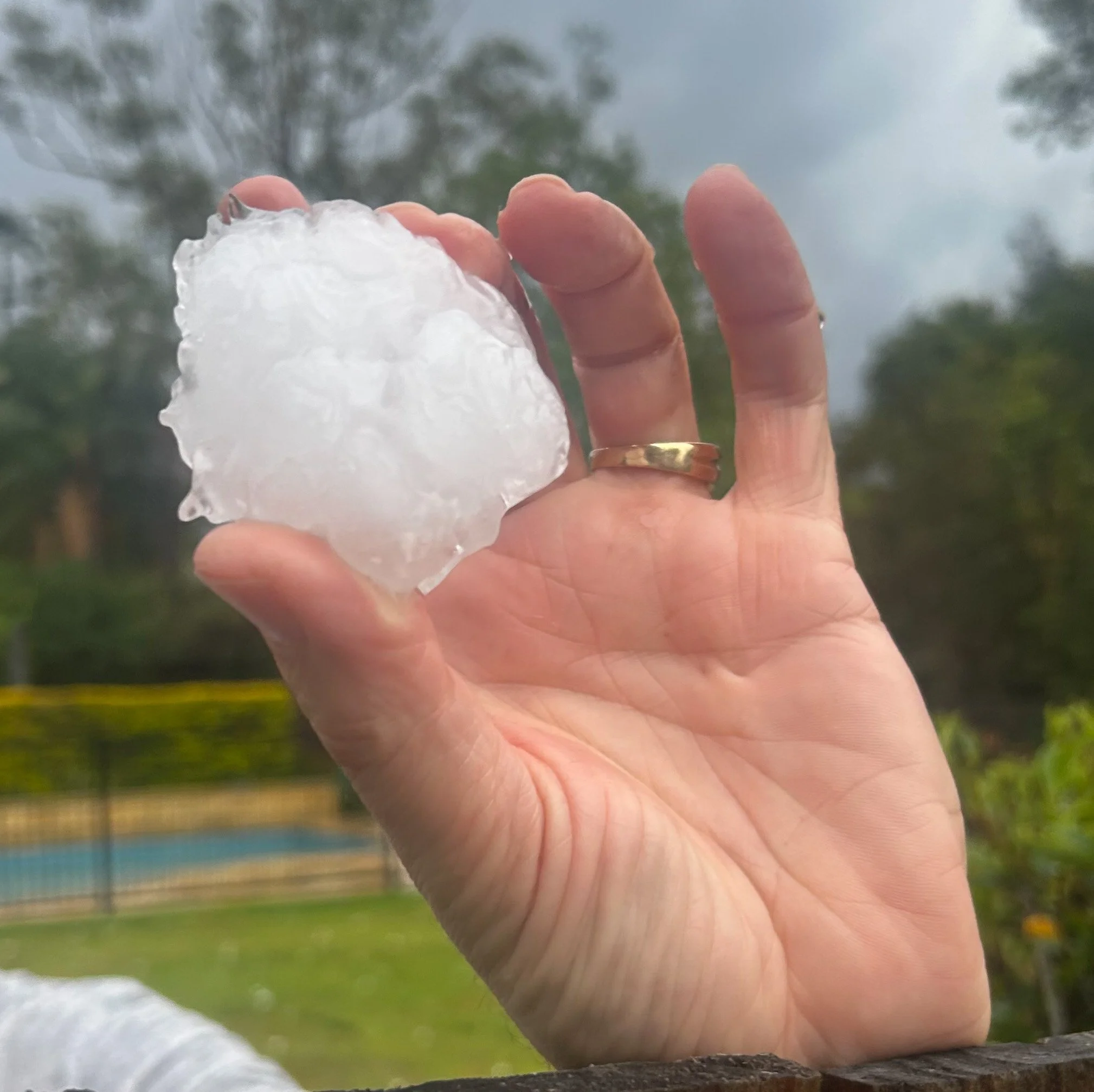
We're discussing where we are at with climate science. Professor Hamish McGowan is my guest. You mentioned hail and the ability potentially to make predictions of both size and location of the falling. At the moment, for a lot of people, the problem with forecasters is that they didn't tell them the right size of hail. was watermelon and you said it'd be grapefruit or getting the right fruit related relevance there, you're talking about effectively looking at both the size of the hail as it is first observed and then also interpreting where that may fall and what effect that will have on its size at ground level versus at the top of the storm.
Hamish McGowan (41:32)
Yes, yeah. got, you know, I need to highlight, you know, lot of the work that I'm talking about is not just done by me, it's done by a team. And that team usually involves some very capable, if not brilliant, students over a number of years that I've had the privilege to work with. And that's one thing that keeps me getting up and going to work on a daily basis is that I get to interact with young, bright minds that hopefully keeps mine you know, from getting too jaded, but in terms of, and one of those students worked on hail, being able to identify hail in storms using radar observations. And then also not just identifying the hail, but actually being able to replicate and observe, or basically simulate the three-dimensional wind field in the actual storms. Because once you have that information, then you can start to model very precisely where the hail stones are going travel through the storm and then exit and travel to the surface. And that's part of the equation that's been missing for a long time is to be able to do that almost in real time. And once you do that, then you with the radar information you can also identify size to some degree. From size and the three-dimensional wind field in the storm you can start to calculate the velocity of the hailstone and the kinetic energy that it's going to have and the likely damage that it's going to cause on the Earth's surface.
David Curnow (43:08)
And what difference is that? We talk about the fact that a hailstone falls, a lot of people just, and I'm certainly one of them, I always tended to imagine that it's purely size, despite what I'm told. Size matters in that if it's a bigger stone it'll cause more damage, but it's not necessarily just the weight of that stone, is it? Or ice?
Hamish McGowan (43:27)
No, it's not just the size. Size is fundamentally important to the magnitude of the damage as we've seen here in south east Queensland over the last couple of weeks or last month. But it's also the velocity at which the stone is coming to the surface has an impact, of course, it has a relationship, you know, the momentum that it has, the kinetic energy that it has when it impacts the surface, whether that be your window, the roof of your car or whatever, but also the number of stones that are falling and that size distribution. So it's all important and we're currently seeking to, or in the process of building up a research program with researchers from UQ but also the Bureau of Meteorology, to actually use AI to be able to improve our prediction of severe storm hazards like large hail, ⁓ but also winds, flash flooding, and actually do that in what we call "nowcast" timeframes. So.
David Curnow (44:37)
That's a word I just loved. It jumped out at me in a few different publications that I've read looking at this. The word "nowcast", and I've even told it to my kids, the difference between a forecast and a nowcast, how now are we talking, brown cow?
Hamish McGowan (44:52)
Well, we're talking out to sort of 60 minutes. So really the period of interest from the next five to 60 minutes. That storm that's moving through Beaudesert, is it going to turn to the right and go out through the Gold Coast, or is it going to come straight through Ipswich and through the western suburbs of Brisbane where I live and deliver 10-centimetre hail? That's the timeframe that we're working on and improving our predictions of the hazards associated with severe storms. And while it may not sound like much, 10 minutes or 15 minutes is enough for people to get their cars into a garage. It's enough to change plans about school pick-up. It's enough to say, okay, we need to get the sports team off the field. It's those sorts of impacts that we're hoping to have with this work.
David Curnow (45:49)
And you mentioned the Bureau of Meteorology and that's certainly in Australia the body that is involved in most of the forecasting that most of us I suppose hear. Sometimes they are maligned because people perceive that either the warnings were too serious and it didn't eventuate or not serious enough and so they didn't take it seriously. One of the difficulties of course is if you don't know where it's going to fall, you can see that there is a storm with the potential of these things, people tend to downplay it. If you can turn that into a model that gives you more specificity within that time frame, it makes a radical difference, I suppose, not just for mums and dads, for kids, but businesses, insurers, the ability to tell that sort of thing.
Hamish McGowan (46:33)
Yes, yeah, and I mean, you know there are some significant challenges here. We've spoken about the fact that the atmosphere is an inherently complex beast to try and understand and to be able to simulate accurately to give us accurate forecasts. know, someone in one side of a suburb might say, the forecast was wrong because I didn't get hail, but you could go 500 metres away and you could find someone had four centimetre hail and the car was being completely destroyed, that is very hard at present to give that level of confidence and resolution and forecasts. And it's going to be at some point in the future we will get there, but I think to be fair, you should listen to the warnings that are issued and maybe just keep an eye on what's happening in the sky.
David Curnow (47:35)
Yes, I think that's been noted a few times in recent social media outcries over forecasts. If you just popped your head out the window, you would have had an idea. I do like the one line in one of those PhD proposals or publications, sorry, which says a spatial mismatch between radar-based hail swaths and surface hail is commonly noted in meteorological literature. In other words, it wasn't the same size as the social media pictures ended up.
Hamish McGowan (47:57)
Thanks
David Curnow (48:01)
Showing me, therefore, I don't believe any of it, which as you say is perhaps a little unfair. Let's then talk about when it comes to understanding both the past and future of both weather and climate patterns, it's only going to become more important over the years. Are you comfortable or confident that the technology and work being done such as the people around you and other climate scientists will be enough to at least soften some of the blows from climate change?
Hamish McGowan (48:31)
"Soften the blows of climate change"? Right, you're trying to be optimistic...
David Curnow (48:40)
Or make it worse. Your choice.
Hamish McGowan (48:44)
Yeah, I suppose in terms of forecasting the weather, we are inherently going to improve as new technologies, AI, machine learning, it becomes more of a mainstream part of our forecasting and some of the work that's coming out in recent publications highlighting the improvements that these technologies are making over classical deterministic forecasting is really quite eye-opening. In terms of predicting climate, predicting climate into the future, the uncertainty, the error bars are coming down and getting smaller. However, we still have some big challenges. The best we can do with predicting whether or not we've got an El Nino or La Nina happening is typically six months, maybe nine months into the future. So the Earth system is inherently a really complex system. And there's still quite a bit of it that we just don't understand well enough to be able to accurately simulate and develop algorithms that tell us, know, replicate what we observe in the real world. ⁓ But we're getting there. And in terms of whether that's going to, you know, dampen the blow from global warming, it depends how we use it. How we use those forecasts and whether or not we have the will to accept them in the right quarters to then make changes and some of those changes are going to be pretty significant. So there's responsibility on the individual, society and government to ensure that we build resilience because there is enough momentum in the climate system as a consequence of global warming that we are going to you know, socked around the ears. We're going to take a few blows, some pretty serious blows and we can't avoid that because we've gone so far down the path towards the brick wall that we're going to, you know, get scraped. What we can build is resilience into our environment and our society and key infrastructure systems to be able to dampen those shocks that we're going to get from climate change and we should be doing that and I frankly don't see enough progress to do that.
David Curnow (51:20)
Let's put aside negativity, positivity, optimism, or otherwise. Should we all just be nicer to weather forecasters and climate scientists generally?
Hamish McGowan (51:31)
Well, we're doing our best.
David Curnow (51:35)
Professor McGowan, thanks very much for joining me today.
Hamish McGowan (51:38)
Pleasure.
David Curnow (51:46)
Professor Hamish McGowan, and I think it's fair to say he's a climate scientist who has seen the data and is astounded by how indifferent the world is to the changes that it predicts. You can find a transcript of this episode as well as a link to the University of Queensland's Weather and Climate Science Research Alliance website on our website, www.wawawpod.com That's www.wawawpod.com. You can also check out some of our other episodes and from 2026 watch these interviews on YouTube. Music for this podcast is created and performed by Michael Wilimot production assistants from Clare MacMillan. I'm David Curnow Thanks for listening.