
Where Are We At With Frog Fungus (Chytridiomycosis)
Transcript
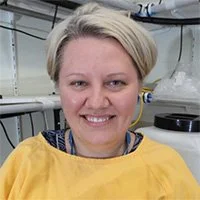
Dr Tiffany Kosch
Photo: University of Melbourne
David Curnow
Welcome to Where Are We At With the podcast updating you on everything, on topic at a time. I'm David Curnow. Frogs tend not to get a lot of love around the world. In fact, we often refer to them in negative terms. Kissing a frog to get a prince, basically doing something unpleasant to yield a positive result. Mark Twain supposedly told us to eat the frog first thing in the morning, meaning do the worst and hardest thing first to get it out of the way. Poor frogs.
Excerpt from The Muppets. Kermit the Frog singing
"It isn't easy, being green."
Yeah, don't eat the frog. Onya Kermit. But it's been even harder to be a frog in the past few decades because what is described as the world's worst ever wildlife disease disaster is happening right now. Most people don't even know about it.
A fungal disease has sent dozens of frog and salamander species extinct and it threatens many more.
I knew about the disease but I admit even I had to Google how to pronounce its name.
Youtube video
"ky-TRID-ee-oh-my-COH-sis"
Thanks YouTube. For a long time we didn't really understand it, where it came from, why some species are affected and others aren't, and more importantly, how do we fight it? One person who is in the front line of the battle is Professor Tiffany Kosch. She's based at the University of Melbourne's veterinary school. She's the director of the Amphibian Genomics Consortium and research fellow with One Health Research Group at Melbourne Uni.
Born in the USA, she's travelled the world following frogs and the fungus, trying to find a fix. Along the way, she's helped sequence the genome of one of Australia's most iconic frogs and identified some of the tough decisions we may need to take to save them. So today, Where Are We At With Frog Fungus with Professor Tiffany Kosch.
David Curnow (02:04)
Dr. Kosch, how are you?
Tiffany Kosch (02:05)
I'm doing great, thank you.
David Curnow (02:06)
Now you are also the director of Amphibian Genomics Consortium. Tell me about that.
Tiffany Kosch (02:12)
Yeah, correct, David. So I'm very interested in amphibian conservation. ⁓ And when I first started wanting to use genetic approaches to help amphibians, I realized that there were a lot of resources and information lacking to even be able to understand or begin to do what we were doing. So I launched the Amphibian Genomics Consortium in early 2023 with some colleague from Colombia and one from Spain to start to generate a lot of these resources and also improve global communication and amphibian research. And so now we have over 400 members from 49 countries and it's been a great way to really start to build some of these necessary resources.
David Curnow (03:03)
It's incredible to think that it is such a global push because it is pretty much a global problem. Let's start with that. How big a deal are we talking with some of the challenges we're facing with the frog fungal disease?
Tiffany Kosch (03:19)
Yeah, David, so it's a really big deal. the disease, chytridiomycosis, on record is the worst infectious disease ever recorded in wildlife. And this is a global problem. So as of this time, there are 90 amphibians that have already been driven extinct by the disease and another 500 that are under severe threat.
David Curnow (03:47)
I mean those are incredible numbers when you think about it and the fact that even this morning mentioning to a friend of mine having a chat with you and they said, there's a frog fungal, amphibian fungal disease. I didn't know about it. It's amazing that it is so big and yet a lot of people aren't yet aware of it.
Tiffany Kosch (04:05)
Yeah, yeah, it really is. I think a lot of it is because, you know, frogs tend to get overlooked for more charismatic animals like koalas and sea turtles. They're small, but they are a very important part of the ecosystem. So their loss, you know, has major impacts on things like human health, which, you know, is a major problem.
David Curnow (04:28)
Let's talk a little bit about the history of it because I understand that it's something that it's been around for a little while, but actually identifying it only occurred in the last few decades.
Tiffany Kosch (04:40)
Yeah, that's correct. So before this disease was discovered, it wasn't really thought that ⁓ diseases in wildlife could cause major declines and especially extinctions. And so when amphibians started to decline, ⁓ this occurred mainly in Central America, in Australia, where these declines were first noticed, people were thinking of a lot of other things. So thinning of the ozone layer, pollution, climate change, those types of things, and no one was thinking about disease. And Australia's own ⁓ Lee Berger, who's a scientist that I work with at the University of Melbourne, was one of the people that discovered that these declines were being caused by this chytrid fungus ⁓ in Australia. ⁓ And so she actually discovered this during her PhD, ⁓ and this kind of happened in parallel with some scientists working in the United States at the Smithsonian Zoo. And so, and then once people started looking for it in the environment, they found it in many places and found that it was causing a lot of these declines.
David Curnow (05:52)
And we mentioned that it affects both, ⁓ all types of amphibians, sorry. Does it affect some more than others?
Tiffany Kosch (05:59)
Yes it does, so that's why it's such a problem. So it can infect all types of amphibians, so this is frogs, salamanders, and caecilians. ⁓ But the main, and there's actually two types of chytrid fungus. There's one that's called BD and one that's called B. sal. Most of the work is with BD, just to make things more confusing. That's the one that mainly impacts frogs and then B. sal mainly impacts salamanders ⁓ And so to date BD is the more widespread species of the fungus and it's causing a lot more declines.
David Curnow (06:38)
And is that the fungus itself that is the problem? Can you carry the fungus and not be affected?
Tiffany Kosch (06:45)
Yes, you can. they're one of the challenges with the fungus is since it infects all amphibians and they vary in their susceptibility, there's many ⁓ frogs, for instance, in Australia that can carry the fungus and it doesn't kill them. And so it makes it very hard to eradicate it from the environment because these non-susceptible species keep it present in the environment and then the susceptible ones die off.
David Curnow (07:13)
And how does it affect them? When we're talking about a creature that is both infected with it but also suffering, what does it do to them?
Tiffany Kosch (07:22)
Yeah, so what it does is it infects the cells in their skin and that might not seem like something that would lead to death, but amphibian skin is very important for respiration and also obtaining ions and water from the environment. And so basically what happens over time is due to the poor ion regulation, the frogs actually die of a heart attack eventually from the disease.
David Curnow (07:50)
Right, and if you find one in the wild that's been affected by it, there any symptoms other than it's dead?
Tiffany Kosch (07:58)
It's a bit hard to diagnose. So basically the best way to diagnose the disease is using a PCR test similar to what was done initially for COVID-19 in humans. So it's basically sequencing a part of the genetic region of the fungus to confirm. And that's because especially in the initial phases of the disease, it looks like a lot of other diseases like bacterial diseases, ⁓ toxicity, poisoning, et cetera. But once you'll tend to see the frogs lethargic, potentially reddening of the skin, just looking very sickly, especially in the later stages of the disease.
David Curnow (08:39)
And again, with a lot of people not particularly aware either of the condition or what it does to the creatures, they think, well, gee, where's the fungal disease, bad athlete's foot, give it some "Canestan", some antifungal and off we go. Can it be treated individually? Can an affected frog, found in time or salamander, be found in time, be treated?
Tiffany Kosch (08:59)
Yes, it can. So there are a couple antifungal drugs that are very effective at treating it if the frogs are brought into captivity. ⁓ And so if any members of the public find frogs that are clearly sick, I would recommend taking them to their local veterinarian ⁓ and they may be able to treat it or at least get the frog to somewhere it can be treated or diagnosed for the disease.
David Curnow (09:25)
Of course that is treating the condition very much at a micro level and effectively after the problem has begun. In addition to that of course we always tell people not to handle amphibians because of that very nature of their skin and how important it is to them. Let's talk then about where it came from. Do we have any idea of its history, how long it's been in the environment and affecting creatures?
Tiffany Kosch (09:50)
Yeah, so most evidence points to the origin of the fungus in Asia, potentially Korea. ⁓ And this is because if you look there, the amphibians are very tolerant of the disease. It's quite widespread and doesn't have any impacts. And it also has the highest genetic variation in Asia. ⁓ And then it's thought that it spread globally in the 1980s to the Americas and places like Australia and Europe by the movement of amphibians. So amphibians are moved for the pet trade, for laboratory research, and also accidentally by traveling in fruit and plants, etc.
David Curnow (10:34)
As anyone who lives in Australia knows, cane toads certainly can happen that way, even if they were bought here originally. Deliberately. I understood, and reading a little bit, that there was even a theory for a while that it was pregnant women who played a role in the spread of some amphibians around the world.
Tiffany Kosch (10:50)
Yeah, that's correct. So an early theory was that it came out of Africa and that's because African Clawed Frogs were used historically for pregnancy testing and those have also been widely introduced into the environment. But future research has shown that it was more likely Asia than Africa.
SIDENOTE
David (11:10)
Okay, a quick note on this frog pregnancy test for women. As Dr. Kosch says, we now don't think it's relevant to the fungal disease, but it's bizarre enough that we'll mention it anyway. Basically, between 1930 and 1960, the best way for women to test if they were pregnant was to pee on a frog. Okay, so not actually pee on it.
In the late 1920s, British and South African researchers discovered that female African clawed frogs would produce eggs within 12 hours of being injected with any urine containing the pregnancy hormones. Previously, doctors injected urine into mice or rabbits twice a day for three days, and then they cut them open to check if their ovaries were bigger. So the frog trick, known as the Hogben test, saved time, effort, and the lives of a lot of mice and rabbits. But then of course they discovered those sticks that allow instant pee testing. Or something like that. Hey, we're here to talk about frogs. This is not Where Are We At with Pregnancy Testing.
RETURN TO INTERVIEW
David Curnow (12:09)
How does the fungus itself spread? we know? I it's fungus. They're tiny spores. Obviously, it's always going to be a challenge. I assume it's difficult to get a frog to hang around with other frogs.
Tiffany Kosch (12:21)
Yeah, yeah, that's correct. So ⁓ it's an aquatic fungus, so it can move through water, you know, through streams and rivers, etc. It can also be spread by humans. So that's why it's very important to try to wash your boots and gear like nets in between aquatic sites so you don't spread the fungus ⁓ and potentially also via other animals. like birds, like ducks move between bodies of water and it could potentially be carried on their bodies as well.
David Curnow (12:54)
We mentioned a little bit earlier that Australia was a place where it was, I suppose, detected and you mentioned some of the people involved in that. I understand, was it Queensland that had the dubious honour of the first official detection of the epidemic, as it were, the type?
Tiffany Kosch (13:09)
Yes, that's correct. So there were a lot of frogs dying off in northern Queensland. ⁓ And subsequently, it's thought that it was introduced through the port of Brisbane. And if you look at the spread of the fungus, it likely spread up and down the east coast of Australia after this introduction.
David Curnow (13:29)
And is that why you came to North Queensland early on? I understand you headed to James Cook University.
Tiffany Kosch (13:34)
Yes, yes. So I was actually ⁓ in Korea before I moved to James Cook University working where it likely originated, but ⁓ was getting a bit tired of basically just describing what was going on and not doing anything that was going to lead to conservation action. So moved to JCU to work on trying to conserve Corroboree frogs, which are very threatened by the disease.
David Curnow (13:59)
Indeed, we will talk about Corroboree frogs in a moment. Dr. Tiffany Kosch is my guest today. She is studying a number of ways we can use genetics to fight fungal disease, chytridiomycosis There you go, my practice paid off, even though it took a while to get there. ⁓ Let's talk then about where it is worse, because we said that it's spread around the world, but it is affecting some areas worse than others.
Tiffany Kosch (14:25)
Yeah, that's right. So the fungus likes cool, wet areas. And so it tends to do a lot better in areas with those climates. And so in Australia, these would be mainly upland areas in Queensland. ⁓ And down in the south in Victoria, there are a lot of frogs threatened by the disease, and also species like the Corroboree frogs, which are found in the alpine regions of Australia. So hot, dry climates, it doesn't tend to do very well. And then among those areas, you need susceptible species. And so that varies quite a bit as well. And that's one of the things that my lab is beginning to look at is why some species are more susceptible than others. And we don't really have a very good understanding of that at this point, unfortunately.
David Curnow (15:15)
No, and it's tricky, course, fungus likes cool, wet areas. What do you know? So do most amphibians. So it's a little bit hard then if that's where they're heading and that's where the fungus is heading. I want to talk briefly about frogs because of course, you effectively out of the gate started looking at some of these conditions. Did you always like amphibians, salamanders, frogs, that sort of thing growing up where you were?
Tiffany Kosch (15:40)
Yeah, actually I did. So I grew up in Ohio in the United States. And as a young child, my father especially used to take me out, ⁓ myself and my sister looking for amphibians. So we'd catch a lot of frogs and sometimes keep them for a few days. So kind of just fell in love with them there. ⁓ So yeah, I've been hooked for life basically.
David Curnow (16:04)
Yes, as we can probably tell you weren't originally from Melbourne. What sort of frogs were you catching?
Tiffany Kosch (16:10)
So there are a lot of different frogs. So we had bullfrogs, which people might be more aware of, American bullfrogs. ⁓ And then also lots of really neat little frogs. So we have these cool frogs called grey tree frogs, which are quite beautiful little frogs in Ohio. And we also have a lot of salamanders in the United States. So we'd catch things like spotted salamanders and redback salamanders, which you can often find by just walking around the woods and flipping over rocks. So yeah, it was quite fun.
David Curnow (16:43)
And was this supported by at least your mother or the others? There was nobody who had a fear or distaste for them?
Tiffany Kosch (16:49)
No, I was very lucky in that my parents actually encouraged this type of behavior, so they never dissuaded me.
David Curnow (16:56)
It's interesting that they are a little bit divisive at times though, aren't they? I have an aunt who absolutely loathes frogs, for instance, and I have another aunt who just adores them and everything has to have emblems of frogs. So they can be a little divisive at times, can't they?
Tiffany Kosch (17:07)
Yeah. Yeah, yeah, you never know. And even today, sometimes my parents question my career directions, like why I would want to spend my whole life working on frogs.
David Curnow (17:20)
Do you get much chance with what you're doing now to actually be out in the fields looking at the frogs and their environment itself or is it more laboratory and through a microscope?
Tiffany Kosch (17:29)
At the moment it's mostly lab-based, starting to do a little bit of work with frogs and the environment as we prepare for release someday. But yeah, most of it's unfortunately in a lab or behind a computer.
David Curnow (17:46)
You mentioned the fact that you were looking at frogs where you were from. Then you were studying Peruvian conditions for the fungal disease as well as Korea. You've seen a lot of frogs in your life. Are there any particular ones that stand out as favourites to find or favourites to work with?
Tiffany Kosch (18:03)
I guess I kind of have a bias for the brightly colored frogs, so, which tend to be poisonous. saw ⁓ a lot of ⁓ species, diversity of those species when I was working in Peru. And now I'm working with one of Australia's most brightly colored and poisonous frogs, the Corroboree frogs. So, yeah.
David Curnow (18:25)
How important are frogs and salamanders to the ecosystems that they're in?
Tiffany Kosch (18:30)
They're actually quite important and that has to do with their amphibious lifestyle. So a lot of amphibians spend their larval stage in the water and then they move to land. so most of us are probably at least somewhat aware of problems with nutrients building up in the environment, which can cause things like algal blooms and fish and animal die-offs. so amphibians are really great at moving these nutrients back on land. They're also very important for controlling pest insects like mosquitoes. And so these declines from chytrid have been associated with increases in malaria in places like Panama. And so once the amphibians are gone, you tend to have increases in mosquitoes and then human disease.
David Curnow (19:18)
A lot of people tend to, as you mentioned earlier, concentrate on, the fluffier or cuter in photos animals, whether they be your deer, your bison, your bear, your kangaroo, your koala or whatever. Perhaps some of the smaller creatures don't get the attention, but they can be important to humans as well, not just through controlling pest species like mosquitoes, I understand, but even from a genetics perspective.
Tiffany Kosch (19:42)
Yes, they are. So they have very weird genomes and we're just beginning to understand what's going on. But one really unique thing about frogs is they secrete a lot of different antimicrobial compounds and also compounds that are potential anesthetics. So, which are completely unique to those produced by, for instance, fungi and bacteria, which are often used. ⁓ And so, you know, the extinction of these frogs before we even understand what compounds they're producing could lead to, you know, us not under or detecting these potential medical compounds.
David Curnow (20:21)
Obviously the use of genetics and the examination of the genomes of some of these creatures is a fairly recent phenomenon. I know that in Australia they've been sequencing a few of the creatures here, Tasmanian Devils first off for the facial tumors, probably going to be another topic of where we're at with, to be honest. The first amphibian not until 2020, so it's a very recent phenomenon here at least.
Tiffany Kosch (20:45)
Yes, it is and worldwide as well. So when I first started this work, you know, 10 plus years ago, there was just one amphibian genome and that was for the African Clawed frog that we talked about earlier. ⁓ So things have really been changing rapidly because now I don't remember the last count for Australian frogs, but there's over a hundred frog genomes available now worldwide. And I think we probably have 10-ish for Australia and these are now increasing at quite a rapid rate due to developments in technology. So it's a great time to be working in the field of amphibian genomics and conservation.
David Curnow (21:24)
I did jump onto the website for the Australian genetic map or effectively the collection of all the different genomes that have been collected and at the time the update which was recently was only about six or seven for Australian creatures and that includes cane toads so I don't know if we count that one necessarily as ours but even though it is now a super creature the Australian cane toad.
Tiffany Kosch (21:38)
Yeah.
David Curnow (21:49)
Given that some of them have been sequenced, a lot of people might think, well, there's a small frog. There's another small frog not too far away. How different can they be?
Tiffany Kosch (21:59)
Yeah, so they're actually quite different and that's in one major way is their genome size. So one really amazing thing about amphibians is they have basically the largest range in genome size of any animal. So their genomes can be smaller than a human to many times the size of a human. ⁓ And these are even within closely related frogs. So I work mostly with Australian ground frogs, which include the corroborees and those have a genome three times the size of a human genome. So why this is and the impact of it, we have no idea at this moment. So quite a fascinating area of research going forward, I think.
David Curnow (22:44)
And I understand quite a lot of it non-coding as well, so we're still not entirely sure what's going on there.
Tiffany Kosch (22:50)
Yes, exactly. it is non-coding and historically non-coding DNA was just called junk DNA and it was thought to be worthless. But there's a lot of research coming out that it has quite important impacts on things like health and disease risks. ⁓ yeah, probably hopefully in the next five to 10 years we'll have a better understanding of how that impacts things like chytrid susceptibility and frogs.
David Curnow (23:17)
Just very briefly staying on that, size of the genomes and things like that, for those of us who are not genetics experts such as yourself, why is that relevant? You look at species such as the great apes, look at species such as canids or something like that, nowhere near the variation.
Tiffany Kosch (23:35)
Yeah, that's correct. So most mammals, genomes are about 3 gigabases. And to give you an idea for amphibians, theirs can range from about 1 gigabase to about 130. So some of them are just really huge.
David Curnow (23:51)
And we just don't know why that would be and what diversity that can create. Does it create a chance or a likelihood of more mutations or adaptabilities within those?
Tiffany Kosch (24:05)
Yeah, that's correct. So this is a field that's not well understood in basically any organism, why our genomes are so large. So even in humans, most of our genomes are made up of this non-coding DNA. And there's a lot of theories. So it can both be advantageous and detrimental to have a large genome. So as you mentioned, having lots of extra potential genes could allow more genetic variability. ⁓ And this is definitely true for things like immune genes. So having more variability can actually be beneficial when you're responding to pathogens or novel pathogens. But on the downside, every time a cell divides, it has to make a new copy of the organism's genome. And if it's really large, that's ⁓ a lot more expensive for the organism to achieve and also it slows things down. And so, but yeah, in general, we just don't know the impacts for many of this genome site, for these genome sizes.
David Curnow (25:15)
So it's all still fairly early days in terms of understanding what's going on. In a sense, it's just a case of trying to gather as much information as we can and have a look at it and see where it leads us.
Tiffany Kosch (25:26)
Yep, yep, exactly. And also just trying to understand what's going on in these non-coding regions. And so this is important to understand for amphibians and amphibian conservation, but also for things like human health, et cetera, because, you know, we all share or most of the same genes, at least in some variation. So things that have an impact in frogs may also have an impact in humans and other organisms. So, yeah.
David Curnow (25:53)
I remember the headlines when they came out, I think it was about the African Clawed Frog of we share this much percentage of our DNA with the frogs from many hundreds of millions of years ago. I mean, the connections are there, we're all living species, we've all effectively come from a similar basis somewhere. So I guess that it's all relevant. Tell me a little bit about transcriptomics, because this is a word I had to look up as well as I read through some of your research and others. What's important about that?
Tiffany Kosch (26:12)
Yeah, yes, exactly. Yeah, so I guess to kind of go back a little bit. So we're using a few different approaches to try to understand the genetic basis of susceptibility to chytridiomycosis ⁓ in Australian frogs. And one is looking at their genomes, which is basically encoded in the DNA. And the other approach is kind of coming at it from a different angle, which is transcriptomics. And this is where you're looking at ⁓ express genes. And basically this is, as we were just talking about, a lot of the genomes of animals ⁓ are non-coding DNA. And so that, none of that is going to make it into what's known as the transcriptome, which is the express genes. And so that's why we're kind of using the two different approaches. One, where we can study both coding and non-coding.
DNA and the other where we're just going to look at what's expressed. And that is kind of the reason that we're doing this is it will hopefully help us pinpoint what genes are actually important for response to chytridiomycosis. Because right now we've basically identified hundreds of different genes, ⁓ potential genes, and we need a way to narrow them down. So that's one of the reasons that we're using that approach.
David Curnow (27:44)
And why did you pick the Southern Corroboree Frog? I know you mentioned colourful is always nice. (Were) there any other reasons?
Tiffany Kosch (27:52)
Yeah, so there's a few reasons. One, it's very susceptible to chytridiomycosis ⁓ and can no longer, it's basically classified as functionally extinct, which means without human intervention, it would go extinct quite rapidly in the wild. ⁓ So basically this species needs a solution to restore it to the wild. Otherwise it's going to have to remain in zoos and enclosures ⁓ indefinitely, which isn't great. ⁓ So that's one reason.
David Curnow (28:25)
It is incredible to think of frogs, you're right, we often don't. ⁓ Cane toads, unfortunately, tend to spring to mind, which never gives us a good image, and then maybe a green tree frog in the downpipe. But a third would be southern Corroboree frog, even just the image, if people don't know the name of it, even The Wiggles sang about it.
SONG The Wiggles
"Gunna tell you a story about a little frog, he's got stripes, yellow and black."
RETURN TO INTERVIEW
The fact that it could literally not exist in the wild anymore is stunning to think.
Tiffany Kosch (28:57)
Yeah, yeah, and it's very sad because really they're one of Australia's most iconic species in my opinion. Really beautiful bright yellow frogs and very important also to the indigenous people of the region. So their loss is impacting many people whether they're aware of it or not. So the other thing I was just going to say is that ⁓ there's already quite a large ⁓ captive breeding program in place for this species, which isn't true for a lot of other threatened frogs in Australia. And this is spread across institutions like Taronga Conservation Society Australia and Zoos Victoria. And they've been very helpful ⁓ in supporting this research and we wouldn't be able to do it without them because our lab doesn't really have the facilities to breed frogs for the research that we're doing. So it would be much harder to do with another species. So that's kind of one of the other reasons that we chose the frogs, that there are a lot of resources available for their research.
David Curnow (29:57)
Whatever it takes, explain to people what the process is because people have heard of, well, the human genome projects. Okay, we did that. We've sequenced other genomes. How does it work? How do you sequence a genome?
Tiffany Kosch (29:59)
Yeah. Yeah, so basically what we did for the corroboree frog is we took some animals that had that came from the zoos and we collected tissues from these frogs and actually sent them to the United States to a group called the vertebrate genomes project. And this was almost 10 years ago now. And kind of the reason that we did that is the technology, as I said, are rapidly developing and it would have been very hard for us to sequence such a large genome in Australia at the time. However, now we've subsequently been able to do it on our own. But basically then what you do is you have tissues from the frog ⁓ and the DNA is extracted through some chemical means which purify it by getting rid of all of the other components ⁓ from the animal. And then you chop up the DNA into lots of different little pieces and then you put them in a sequencing machine which basically reads the genetic code until you end up with lots of little pieces of the animal's genome and then you have to go back and try to assemble those ⁓ into the chromosome level so you can start to make sense and generate what's called a genome assembly.
David Curnow (31:34)
You mentioned the fact that ⁓ we're talking about variation in terms of size of these genomes and particularly in amphibians they can be really quite large. What about chromosome? Are they also commensurately large?
Tiffany Kosch (31:49)
Actually not. So ⁓ frogs tend to have ⁓ fewer chromosomes than humans and corroboree frogs just have 13 but they're just very large so much larger than our chromosomes.
David Curnow (32:04)
What were some of the things that you learnt from doing this? Well, any surprises?
Tiffany Kosch (32:09)
So one of the things that we learned, at least for the corroboree frogs, is they have one of the highest ⁓ non-coding DNA contents for any animal, and it's about 80%. So I said earlier that humans tend to be about 50%, so we know that about 80 % of their genome is non-coding DNA. So that's quite interesting.
David Curnow (32:36)
Wow. Can we take that genome then and compare it to other amphibians, particularly say small frogs with different susceptibilities? Can we take any correlation and look at them to find some of our susceptibility or resistances to the chytrid fungus?
Tiffany Kosch (32:52)
Yeah, exactly, David. So that's one of the approaches that we're going to be using going forward. So there's another really unique little frog in Australia called the Common Eastern Froglet which is quite widespread across the east coast. Most people might be familiar ⁓ by seeing it in their backyard or little ponds. But this little frog is quite unusual in that it's related to the corroboree frog. So it's another type of ground frog. But it's completely tolerant to chytridiomycosis. So it can have the disease, but it doesn't have any impact. And we have no idea why that is. So we've just sequenced the genome of this little frog. And going forward, we're going to be comparing it to that of the corroboree to see what the differences are. Because this will hopefully help explain why they're so resilient. And we might be able to use this for some approaches going forward.
David Curnow (33:48)
We talk about approaches and flippantly mentioned anti-fungal creams a little bit earlier. Obviously, as I mentioned, that's a very micro and individual level treatment and you can't treat every one centimetre long frog in the world. What are some of the ways we can use genetic information to help fight something such as this moving forward?
Tiffany Kosch (34:12)
Yeah, good question. So I'm very interested in using genetic approaches for Corroboree frogs and other species threatened by chytrid. ⁓ And I don't take this lightly. So I'll just say there's been about 30 years of research trying to develop mitigation approaches for chytrid. And these include environmental things like using chemicals in the environment, chemical disinfectants in the environment to get rid of it, vaccinations, probiotics, ⁓ lots of different things have been trialed. And so far nothing has been very successful at eradicating the disease or the pathogen from the environment. ⁓ And so it doesn't seem like it's going to be possible. ⁓ And our goal in our group ⁓ is to restore populations of Corroboree frogs to the wild. And basically we call them self-sustaining populations. So they will no longer require human intervention. We release the frogs, they're able to survive alongside the pathogen and are healthy. so genetic approaches allow us to do this because they cause heritable changes in the frogs. So this means the frogs that we release will pass this resistance onto their offspring. So that's the one of the major benefits of genetic approaches. ⁓ Another major benefit is they're very targeted. So if you think of, if you're putting like a chemical spray into the environment, it's gonna kill a lot of things that you don't wanna kill, which are known as off-target effects. Whereas when you're just manipulating the frog, ⁓ it's just gonna change the frog. And so a lot less chance for these off-target effects with this approach.
David Curnow (35:56)
Obviously one of the challenges in a situation such as this is by not knowing everything about the genome of a particular creature as we very rarely do or never do, are we ever sure about what a single change can do ⁓ moving down the track?
Tiffany Kosch (36:17)
Yeah, so you can never be 100 % sure what the impact of a genetic change is, but in our case, we'll be able to very carefully vet these frogs before release. So we would first evaluate them in the laboratory. And then for the corroboree frogs, there are already enclosures existing in their natural habitat in Kosciuszko National Park. So we would then... do a lot of research with the frogs there before ever considering releasing them to ensure that they are the same as their wild counterparts besides being chytrid resistant.
David Curnow (36:54)
Does it make them genetically modified? Does this count as a genetically modified organism if we were to tinker with the genes?
Tiffany Kosch (37:02)
Yeah, so basically my group is going to be trialing two different approaches. ⁓ One is called selective breeding, which is basically what we do in things like dairy cattle and the domestic dog. So that wouldn't be classified as a genetically modified organism. But we are also going to trial genetic engineering approaches, which could be things like gene knockout or gene knock-in with approaches such as CRISPR and depending on the approach that we use, those would be classified as genetically modified organisms. And so their release into the environment is much more controversial and we would have to follow a regulatory pathway for their safe release.
David Curnow (37:50)
At this stage though, it's effectively about dealing with each creature's own DNA and its own genetic material. We're not effectively mentioning trying to get something from another creature and putting it into their system.
Tiffany Kosch (38:04)
Yeah, so basically what our plan is is to use naturally existing chytrid resistance genes. So we've done a lot of research in Corroboree frogs, which actually vary quite a bit in their chytrid resistance to try to understand what genes are making some individuals more resistant than others. But then we're also considering approaches like that little common Eastern froglet that I mentioned, so if we were to potentially find some type of resistance gene in that frog, we could potentially consider knocking it into a Corroboree frog and seeing what the impact of that would be. But we're just working with genes that are already present within frogs.
David Curnow (38:47)
For most of us, think the idea of saving a creature through whatever means is fantastic. There would automatically though be some pushback from some sectors. What does that, what form does that take?
Tiffany Kosch (39:00)
Yeah, so that's a very important part of our research program as well is developing a social license for this approach. ⁓ And so I've begun some pilot work to understand what the Australian public thinks about this approach. And I'm also working with traditional owners throughout the whole part of the planning process to make sure that we have their support ⁓ as well. So it's very important. And I've also been very involved with this at the international level through organisations such as the IUCN and the Convention on Biological Diversity. And this has been quite a hot topic for both of those organisations and is quite controversial. So there are many people in support of it and then just probably about as many against it. So I think it's going to be challenging going forward. ⁓ So yeah, we'll see what happens.
David Curnow (39:57)
And look, as technology changes, this is a long way from genetically modified wheat that somebody might be growing 20 or more years ago, the technology of things like CRISPR, the ability to get so finely detailed, it really does change things and we have to effectively change our own moral compass, I suppose, or our own perception of what is happening.
Tiffany Kosch (40:20)
Yeah, I think so, David. And I think one thing that a lot of people don't ⁓ understand that are maybe a bit fearful of these approaches is they're actually adapted from things that occur naturally in nature. So ⁓ the CRISPR, for example, is basically ⁓ a method that bacteria use for viral resistance. So we're not using anything that doesn't already exist in nature. We're just kind of taking control of it as humans to help things like these frogs be able to survive. And so, and also, as I said earlier, these approaches are very targeted. basically when I look at this, this chytrid problem, and I'm trying to restore frogs to the wild, I'm trying to think of what method can we use that's gonna have the least environmental impact and be the best for the frogs, because we really need to get these frogs back into the environments. They're basically not fulfilling their roles in the ecosystem at this moment because there's basically less than 50 individuals left. ⁓ And so it seems like these approaches are very promising and we can actually evaluate things like the frogs genome after we use CRISPR to ensure that the edits that we have performed have occurred in the correct spot and they don't have any other unintended impacts.
David Curnow (41:41)
For your team, for your group, your work at the moment, we mentioned the work on the Eastern Froglets. What's next for you in the next couple of years and what's the highest priority for you?
Tiffany Kosch (41:41)
Mm. So ⁓ we've actually shown that chytrid resistance is heritable in corroboree frogs, and we've developed ⁓ a plan to selectively breed them for resistance. And so we plan to start that within the next couple of years and then start evaluating the effects of this ⁓ in the lab and then in those enclosures and Kosciuszko that I mentioned and at the same time, we've been working to really understand the genetic basis of chytrid resistance, mostly in Corroboree frogs. But as I mentioned, we're now expanding to this common Eastern froglet. And so this will allow us to allow or to identify a lot of gene targets that we can use moving forward to trial some genetic engineering experiments and see what the impact of that is. So ⁓ I would say within the next five years or so, we should have an idea of how the selective breeding is working and then hopefully have some gene candidates narrowed down to trial genetic engineering in the corroboree frogs as well.
David Curnow (43:04)
Frogs as a species have been around over 250 million years. They're fighting things like dramatic habitat loss through human intervention. Climate change obviously has a massive effect, particularly when you rely on certain weather conditions, moisture levels, that sort of thing. And now, Chytridiomycosis. How much hope do you have for the future of amphibians in the world over the next 100, 200 years?
Tiffany Kosch (43:30)
I'm actually very hopeful, David, because I think a lot of our new technologies will help to preserve them. And I think that the public's appreciation for a lot of these species is starting to increase. But at the same time, they still do face a lot of challenges, like you mentioned, ⁓ climate change and fires being a big one in Australia, and then these diseases. I guess my hope is that more investment will be put into research to develop mitigation approaches for these things and hopefully some of these new technologies will help us along the way as well.
David Curnow (44:10)
Well, that is where we are at with frog fungus disease, chytridiomycosis. Dr. Tiffany Kosch has been our guest today. Thank you so much for joining us today.
Tiffany Kosch (44:20)
Thanks so much, David.
David (44:26)
Links to the Amphibian Genomics Consortium as well as a transcript of this episode can be found on our website www.wawawpod.com. That's www.wawawpod.com.
You can also check out our other episodes or drop us a note with any comments, questions or topics you might like us to explore sometime soon here on Where Are We At With? Music for the podcast was created by Michael Willimot with production assistance from Claire MacMillan. I'm David Curnow. Thanks for listening.