Where Are We At With Fashion Part 2

The global fashion industry contributes to modern slavery, environmental destruction, and unrealistic body images. But there are solutions. People like Professor Alice Payne from RMIT are working towards a sustainable, responsible and circular process that allows those of us who wear clothes to make the best choices for ourselves and the planet.


Professor Alice Payne's book "Designing Fashion's Future" can be found here.
To find out more about the "Good On You" app, visit their website here.
More links to topics discussed during this episode, suggested by Professor Payne.
- Future fashion, biotechnology and the living world: microbial cell factories and forming new ‘oddkins’
- Multi-heteroatom doped nanocarbons for high performance double carbon potassium ion capacitor
- Sustainable Substitutes (Pineapple yarn to textile)
- Keeping Clothes Out of Landfill: A landscape survey of Australian consumer practices
- Keeping Clothes Out of Landfill – animation
- Seamless Australia
- Australia’s circular economy: unlocking the opportunities Inquiry report
- Australia’s cotton farmers can help prevent exploitation in the global garment industry
- WRAP – The Global Environment Action NGO
- Fashion Revolution Oceania (Australia)
- Fashion for Good
- Wear Next (book by Clare Press)
David (00:08)
When it comes to fashion, most people don't tend to think about numbers. Why add up when you just want to stand out? Try some of these numbers. One sixth of the world's population is employed in the fashion supply chain. The global textile industry is worth about $3 trillion a year. About 100 billion pieces of clothing are made every year and a third of those are thrown away within 12 months. Hello, welcome to "Where Are We At With...?", the podcast updating you on the promises of the future, made in the past, I'm David Curnow.
This week, part two of a series looking at fashion. We aren't wearing silver jumpsuits suggested by some of the movies, or see-through PVC skirts. At least, not all of us anyway. But we are buying more clothes than at any other time in history. Australia has a small population but is the second highest consumer of clothes per capita in the world. On average, everyone in this country purchases at least 27 kilograms of clothes a year. And in that same year, we each throw out 23 kilos. The vast bulk of it ends up in landfill. The eyes do start to glaze after a while because the stats are just so incredible. And they don't include environmental problems in creating the materials or the use of slave labour to make the clothes. So, what's the problem? Well, a lot of it has to do with something we touched on in last week's episode with Dr. Madeleine Seyes from Adelaide University. Fast fashion, the ability to identify a demand in clothes, produce the items, and get them on the shelves more quickly than ever before. Our guest today is the Dean of Fashion and Textiles at RMIT in Victoria. Professor Alice Payne was part of the Australian Fashion Council-led consortium designing the National Clothing Product Stewardship Scheme. She's the author of the book, Designing Fashion's Future, and co-editor of a publication called Global Perspectives on Sustainable Fashion. Part two of “Where Are We At With Fashion?”.
David (02:13)
Professor Alice Payne, thank you so much for joining me today.
Alice (02:17)
Thanks for having me, David.
David (02:19)
Before we get into some of the deeper and darker sides of fashion, I have to know, do you own trakky-daks
Alice (02:26)
I do, I do actually have a great pair I got a few years ago and they've got lots of pills and but they're super comfortable and they're good for pulling out in winter.
David (02:36)
Absolutely. I suppose I did say last time we spoke about fashion on the show, I would never ask this question again, here I am about to ask it again. What are you wearing and why are you wearing it today?
Alice (02:48)
A great question. Well, I'm wearing a singlet that my sister gave me. I'm wearing a silk shirt that one of my PhD candidates gave me when she graduated as a thank you. And I'm wearing a beautiful second-hand skirt that is from the designers Easton Pearson from Brisbane. So Easton Pearson, an absolutely amazing Australian story who had their label for 30-odd years out of Brisbane, but manufacturing around the world. And I know Lydia Pearson well. so when I found the skirt in a second-hand vintage market, I was like, I have to get it. And it's the most beautiful skirt, silk, hand embroidered, yeah.
David (03:33)
Two things to take from that one, those of you watching along got to see how pretty that particular skirt and the blouse is. Also, to have a personal connection to the people who made you clothes, that must be pretty special.
Alice (03:45)
That's right. That's right for the skirt that was made, but also the gifts. This was completely unplanned, but yeah, the tops I'm wearing were both gifts. Yeah.
David (03:56)
Wow. Okay. Let's get into something a little less boutique, bespoke as it were. Fast fashion. What is it? How long has it been around?
Alice (04:06)
Yeah, so fast fashion is, I guess, defined in a number of ways, but it's really a business model that is about connecting as closely to the consumer as rapidly as possible. So, it really came about around the early 2000s when you saw the rise of, you know, fast internet technologies that allowed real-time data to be fed from consumer to store to design room much quicker. And then in parallel, we saw the production of garments becoming very fast and very responsive. So while it might have taken in the past, say, six months or a year to get a style from concept through to store, with the advent of fast fashion business models, Zara was really the archetype here, you could now do a turnaround in as little as two weeks through activating very responsive, just-in-time productions. That's the idea or theory, if you like, of fast fashion. What's since happened, though, is that the whole speed of the entire system has sped up. So even brands that might have had a big basic offering are now also putting in much faster trend, and this has been a trend for about 15 years or so. And then we're now seeing the rise of ultra-fast fashion, which is even faster, even more targeted, more responsive to analysis by data and algorithms and the like responding in real time and then production becoming faster as a result. A couple of factors too that when this all kind of converged, it was like a real perfect storm that came together in the early 2000s. know, the internet technologies, online shopping, all of that coming in, rapid data, but then also things like the ending of key trade policies like the multifibre arrangement, which meant that now you can get things produced at very low cost in countries that have lower wage economies.
David (06:07)
Is there a particular material, a fabric type that we're thinking of? Is it particular types of clothes, t-shirts, shorts, that sort of thing? Is anything set it apart in those terms?
Alice (06:18)
Yeah, so stylistically, might be rapid changes in trends. It might be, you know, a particular style of dress that that would be. That was where fast fashion started. But now we're seeing, you know, it could be anything and everything. could be, you know, jeans coming in very quickly. And there's certain core basics that you might see like tracksuit pants or like, you know, t-shirts or whatever that are kind of the bread and butter. And then there's a faster trend focus on top. In terms of materials, mean, we have seen a of a great huge uptick in the amount of polyester particularly. That's a very cheap fibre to work with and it can be produced rapidly. It can dye in really vivid colours You can print it really vividly. And that's been a very attractive material for fast fashion too.
David (07:08)
And the changes in these particular fashions, you're talking about the fact that they can be really quite fast. What's driving them?
Alice (07:15)
Yeah, so it was like, know, if we thought back to the, you know, 90s, let's say, and earlier, we saw, you know, the fashion magazines, you know, putting out, this is the kind of aspirational style, they're looking at the runways from previous seasons, and they're interpreting and diffusing that. What we've seen now is that with social media over the past 15 years, people can have this really rapid insight into what's happening on the runways, and then they can knock it off and produce it really rapidly and so you've got this much more compressed trend cycle that's happened with the advent of digital technology. So there's that side of it. So the diffusion of trends is faster. But then you've also got the bubbling up of trends, which is people on the streets styling things in a certain way, TikTok and the like, you, you really seeing that kind of expressive potential of fashion and then new styles and trends bubbling up and companies responding to that quickly as a result.
David (08:15)
So it's not necessarily, as you said, just looking at the fashion runways as such. It might literally be somebody on social media and people looking at it going, gee, I like those pants. I'd like a pair of those.
Alice (08:24)
Exactly. That's right. And so we're seeing this real kind of, I guess, flattening of who influences what. And that's been trend for the past year, at least 15 years now, we're seeing that bubble up.
David (08:38)
Now I know in Australia the ABC's “War on Waste” highlighted some of this changing when it comes to the fashion world. Australia's not alone though, are they?
Alice (08:47)
No, exactly. I'd say that fast fashion is a trend and now ultra-fast fashion. It's really the business model that's, you know, taken the entirety of fashion by storm. There's different speeds within that, of course, but in terms of large global supply chains, know, using data really quickly, responding to consumer desire as quickly as possible, fabricating consumer desire, you could say all of this is really come to a head over the past decade.
David (09:18)
You talk about responding to consumer desires, responding to it, giving them what they want, getting it there really quickly. I it sounds great. What's the downside?
Alice (09:27)
Yeah, well, mean, all of these things, they're not just ideas, are they? They're physical things that require labour. They require energy, oil to make polyester, land and water and soil and inputs, chemical inputs just to grow cotton. And then you've got all the labour involved in creating that, dyeing it. So you've got these really quite complex items that effectively could be worn for an entire lifetime and yet they're really coming in in such a fleeting way. So we've really got the timing completely out. We're making garments from a substance that's millennia old, but it's only for a few weeks. It doesn't make any sense.
David (10:14)
Right, so in a sense it's like the planned obsolescence of cars or mobile phone technology where the idea is we don't want you using it for as long as it can last.
Alice (10:22)
That's right, but turbocharged is the fastest that you'd see it really apart from disposable packaging maybe.
David (10:30)
What then governments and regulators doing about it? I understand the Australian government introduced a scheme called “Seamless”. Tell me a little bit about that.
Alice (10:37)
Yeah, so what we're really seeing around the world is this concept of polluter pays really coming to the fore. So, France has had an extended producer responsibility scheme for quite some time. Other countries across Europe are putting it in place. And here in Australia, we have a mechanism called product stewardship. And that really says, if you're a producer, you should take responsibility for the products that you place on the market across their whole lifecycle, not just when you sell them, you wash your hands and walk away. Stewardship means that you're a steward of that of that item across its lifetime. So, with that principle, using the Australian kind of framework of product stewardship, Seamless was established, backed by and supported by the federal government. Key responsible brands came together and they committed to supporting the transition of Australian fashion to a circular economy. And that really means putting in a fund essentially, committing to a fund that then strategically invests at critical points across the life cycle. So consumer behaviour change, recycling, new business models for fashion, all of them that coming together can help reduce waste over time. So that's a voluntary initiative, though in other countries it's mandatory.
David (11:56)
It's interesting to me how the food and fashion industry are tracking together in this sense. have the processed food leading to the ultra-processed food, the fast fashion leading to the ultra-fast fashion. again, schemes being put in place that are voluntary in the food situation. That means we still have Twisties and the like on the shelves. In the fashion sense, I understand that when this was first released, we had eight out of the top 30 retailers in Australia signing on. Is “voluntary”, well, a cheap polyester tiger.
Alice (12:28)
Yeah, exactly. the voluntary schemes, you know, that they don't work. They really, you really need to set a baseline to go, well, what is acceptable? What does responsibility look like? And you can't have some saying I'm responsible and others aren't, because then you have a situation which they call free riders and where all these brands are free riders on the good work that the small responsible number are doing. So there really needs to be a discussion about, “Yeah, what's actually the baseline expectation of putting a product on the market in Australia?”
David (13:05)
How many Australian companies now or what sort of Australian companies are actively taking part in this and actively doing something both about the supply chain, the labour conditions, things like that, as well as then after the clothing is worn and the disposal thereof.
Alice (13:19)
Yeah, so there's a lot of different factors just there because you've got your modern slavery responsibilities which are mandatory. So, all companies over a certain size have to be reporting on that. For something like Seamless I believe there's, I'm not sure of the numbers. There's about 50, I think, clothing companies signed up. But bear in mind that across the Australian market, there's over 14,000 companies placing clothing on the market.
David (13:46)
Whoa.
Alice (13:46)
Everyone can import something from Alibaba or whatever and just, you know, set up a clothing brand. The barriers to entry are very, very low. And so, I mean, there's a lot of small players and then there's, you know, as you mentioned earlier, probably about 30 big ones. And those 30 big ones comprise a good 60, 70 % of the market by volume. So, yeah, a long, long tale of small companies, in other words. But again, that's why we need a baseline for everyone.
David (14:16)
Absolutely. It does seem to make sense. We'll get onto some of those factors in a moment because so many consumers would not consider fashion to be both a labour concern as well as an environmental concern. But let's talk about consumers themselves because for a long time, their only concern about the clothes that perhaps they were getting rid of, maybe I could donate it to a second-hand store. Is that a type of green washing for the consumer where they can wash their hands of it, so to speak?
Alice (14:43)
Well, some people talk about sort of wish-cycling, you know, hoping that something will be recycled for you and you put it in the yellow bin and off it goes and, you know, you're kind of absolved from any guilt, if you like. So, we did a study in 2024 where we looked at 3,000 Australian consumers and we did find actually a surprising number are putting clothing in the yellow recycling bin, which of course is not an avenue for clothing. We are also finding that lots of Australians really value and really respond to giving to charities and they really are very proactive in giving to charities. I think the critical message that the charities point out is you need to give clothing that is as good as what you give a friend. If it's got damage and holes and rips and things like that, well, that's not something that they can sell, and so then you really get into quite a complex situation where the clothing is likely then to be, you know, take some other pathway where it's less clear what its end of life will be.
David (15:50)
In a sense, you're treating a second-hand shop or a charity shop, something like that, as your waste disposal system. You're giving it to them to take care of and they're set up to sell things, not to allocate where that goes.
Alice (16:02)
That's right. I mean, you know, there's still the sectors really coming together to look how they can make that easier. And there's lots of really interesting innovations there. I think it's kind of to my mind, we have to have a really good discussion about, what's the right amount of clothing to be coming into the country in the first place? So do we really need to have 55 items per person per year imported into the country? What would some kind of cap look like on that? yeah, what's the right amount? Because if we knew what the right amount was, would there be, I don't know, more opportunity to be more inventive and careful with what we have, you know? And you're not left with the mess at the other end.
David (16:52)
Okay, just a quick interruption here. Something that we didn't mention during our chat was the National Inquiry into Waste Management. Not just clothes and textiles, of course. But one of Australia's problems is that this nation buries just over 87 % of what's thrown away. That's the most among OECD countries. That's despite most of that rubbish being recyclable. Thankfully, it's not all bad news, though.
David (17:15)
Professor Alice Payne is our guest on Where Are We At With today. Where are we at with fashion, particularly fast fashion, but also, I suppose, we as consumers, our approach to the clothes we wear. She is the Dean of the School of Fashion and Textiles at RMIT in Victoria. She has been a bit of time in the sunny estates as well. We don't hold it against her for leaving. Talk to me a little bit about that circular economy that you mentioned. What is that?
Alice (17:41)
Yes, when we think about a circular economy, a kind of crisp way to talk about it would be it would be reducing waste and pollution. It would be, you know, keeping products and materials in use for as long as possible. And then it would be regenerating nature. So, if you think of those three elements and then what comes out of that, it means that we keep we keep using things like we keep using our clothing as long as we can. We mend it, we repair it, we kind of in terms of reducing waste and pollution, we think about do we even need it to begin with? So, we might rethink our purchases, reduce the amount we're purchasing, ? recirculate it. All these are strategies as they're known. And then finally, when a material is really at the true end of its life, how can it be recycled and that material recaptured and brought back either into to regenerate nature perhaps or to become the feedstock for a new product? So that's the kind of vision, if you like. And it's one that, you know, it comes from industrial ecology. So, like the name suggests, it's a kind of ecological way of thinking. If you think of a tree, it grows, it drops its leaves, its fruit, it shelters animals. Nothing's really wasted. It's all recirculated. So that's the principle. The practice, of course, is that our ways of working are very, different to that. And most of our products are comprised of things that are hard to separate later. They have either cultural or physical obsolescence, so they don't last as long as they should. And that really makes a circular economy pretty challenging.
David (19:24)
We'll get onto some of the technologies that are out there at the moment or that are coming soon. Some of the work you've done in that space is mind blowing from my perspective, reading through it has been truly incredible. But you spoke about this circular economy and just before about capping potentially the items of clothing that are brought in. You were one of those who were part of a response to the Productivity Commission report into circular economy. People may have remembered the report came out just a couple of weeks ago. The interim report is what you co-authored a response to and you spoke about that effectively and I'll read out one of the lines it was to “Implement minimum sustainability standards on clothing imports and introduce import caps that align with the principle of sufficiency”. In other words, don't import more than we need. I would have thought that's basic business models, is it not?
Alice (20:16)
Yes and no, suppose, because it's well, whose needs are we talking about? If you're the need, if you're a retailer who has the need to, you know, demonstrate your worth to your shareholders and you've got, you know, Australia employs 80,000 clothing retail workers, we have a need, if you like, to keep them gainfully employed. And to do that, you need to have a certain stock of clothing circulating through and being sold. And so it's perfectly rational in many ways to go well. We just, we keep selling more product. I mean, if you could look at it, I run a fashion school, and we have our students coming in and we have to keep educating them and we send them out into the industry. If we have an industry that's 10 times smaller, are we doing ourselves out of a job? So, you kind of think, well, but on a practical level, no, we absolutely don't need as much clothing. So really, we actually need a re-imagined fashion system that means that you actually can have the right material size coming in, but then there's no limit to the creative abundance and expression that you do with that, if that makes sense. It will need a completely different model.
David (21:31)
Yeah, and obviously the imports of clothes are not to keep RMIT's fashion students coming through the doors. But as you say, it is one effect that comes down the line in the same way that we need coal mines to employ coal miners and feed their families. That's not why we need coal. And it is itself is a problem, this is a challenging situation.
Alice (21:38)
Okay. Yeah. When you put it that way, it's a pretty terrible analogy, isn't it? But I mean, there are 80,000 retail workers. yeah.
David (22:03)
They have an influence. It's not to say that it is the primary influence, but it is one of the factors in, as you say, an economy. And to turn that economy circular requires some turning of corners, so to speak, if I can take that analogy.
Alice (22:06)
No. Mmm. Exactly. And to complicate it still further, we're also part of a global economy. we are bringing in cotton and it's being purchased by people offshore who then turn it into yarn, into cloth, into clothing. We're purchasing back that clothing. So, we've got the millions upon millions of garment workers producing this. We've got all the factories, the manufacturing hubs of Asia. Then on the second-hand clothing side, we've got thousands of people relying on the trade of second-hand clothing, which again is a global trade on the other side. So yeah, it's a massive transition that would have to be, to right this ship would be, it's pretty monumental.
David (22:58)
What steps are being taken at the moment that are moving us towards that? Other than something like our Seamless program, are there any other steps that are being taken that is improving that circularity?
Alice (23:10)
Yes, absolutely. So, where schemes like seamless are being made mandatory, that's really important because it means that, OK, there's a fund that is supporting mis-transition. So that's really important. We also have elements like, you know, putting minimum design standards on garments. you know, in Europe, in France, for instance, there's a, you know, if you have a certain expectation of the eco-kind of value of a piece of clothing. Well, then they're proposing a tax if it doesn't meet that, which then of course would tax some clothing more than others. And then that would drive consumer decision making in a different direction. So, there's kind of mechanisms like, yeah, economic incentives that can be, you know, and instruments that can be cleverly, you know, determined to shift where the market goes. And then how do you support companies in that transition is also where those funds can be spent, because it is a transition.
David (24:14)
It is and it requires not just effectively signing off saying yes this is both economically sorry environmentally and morally correct the company has to spend money both on assuring itself checking it out itself as well as then following those regulations and that cost has to be met by someone and I'm assuming that cost isn't meant by places selling two dollar t-shirts, it makes it tricky.
Alice (24:40)
It does make it tricky. We are seeing, I take a lot of heart from what different countries around the world are doing, which is actually pretty exciting. Different governments are working in different ways on this question. And that's something we've been investigating in our research. So, you know, big manufacturing countries like India are actually doing fantastic work to see how they can support, you know, whether it's, you know, decarbonising parts of the supply chain whether it's working with the craft communities and working with the labourers there. And then we even see countries like Germany, which they've had voluntary schemes in place, but then they're like, okay, we're moving to mandatory. And how are the people who worked with us all those years in the voluntary, they're now in a good place because they're set up for the transition really. So, there's different ways different countries are working, which is really exciting.
David (25:36)
So much to follow up with there at another time, think, particularly even looking through history, the idea of the disruption of the fabric industry leading to as part of the Industrial Revolution, the resentment towards big machines, the Luddite movement, all of that coming back to effectively what we're seeing now where big economies such as India or China, where a lot of fabric and textile work was being done, but they're reinventing it. That's a topic for another time. That was me just talking out of turn. Let's talk about the end of life when it comes to clothes. Very few of us think of what the end of life is. My father always had a good way of dealing with end-of-life stockings from my mother. He would use them to tie things. That was his method, or perhaps to strain liquids. But a lot of us don't tend to think about it. How hard is it to recycle clothes?
Alice (26:24)
Yeah, so you think of an item of clothing that you or I are wearing, often they're not one single fibre. There might be several fibres. It might be a blend of cotton and polyesters, so a synthetic fibre with a natural. And so first you have to get those two fibres separated and then you have to find an end market for the off-take. Who will pay you for what you've done with that recycled material? So we do see some great innovations in this area. So Blocktexx based up in Queensland, you may know. They have a poly-cotton fibre separation facility in Logan, and they are actually doing this at scale, separating cotton and polyester. We also see enzymatic approaches. So, Samsara, which is based in Canberra, grew out of biotechnology, well, it's a biotechnology startup. And this isn't my area, but my understanding is they've engineered enzymes to eat nylon 6-6. And that allows, you can put in your old activewear and the enzymes can eat that. And then the output at the other end is the monomers or precursors for new materials. So, these are technologies occurring right now in Australia and they're scaling up. Samsara, I believe, will build a plant in Malaysia, I think, but I'll have to check that and BlockTexx is operating at scale at present. Still, it's only a portion, I guess, of the 200,000 tonnes of clothing coming in, as waste into Australia each year. But nonetheless, they're promising innovations. I think, though, that when we're thinking of end of life, we have to think first of the beginning, the decisions made at the very beginning, so, you know, work myself and colleagues, our colleague in industry, Courtney Holm. She had a label, ABCH, a circular clothing label for many years. And we turned her method into a practical guide that any designers can apply for clothing, a kind of checklist to work through to make sure that your garment is designed with the end in mind from the beginning. So how are you considering your fabrics, you know, the blends, buttons, the trims, the care labels, all of those elements have an end-of-life pathway and also do they have a regenerative birth, if you like. So, Courtney's model is, I think, an excellent approach for thinking about circularity.
David (29:06)
How big a shift in the way of thinking is that for a designer? Say 40, 50 years ago designing a product, how much of it was just about what can I do with what's available and who might like this?
Alice (29:17)
Yeah, exactly. when we, in fact, even when we teach design, it's almost like you have this palette of any material, any colour that you could ever want in the whole world. And in fact, that I think is a beautiful thing about fashion too. It's like limitless. It's got this creativity and this expression about it, which is I think what attracts many designers. When you start putting in limits and start going, well, okay, if you're thinking about what's this garment's life across time, it's, I guess, a whole other way of thinking about design. And it can be limiting in one degree, but I think expansive in another way, because it prompts you to think quite differently and also to respect materials in a very different way. But it's not to say there's not a place for the expression. think you have to kind of think about, well, what's the volume I'm putting on the market and what's the purpose of it? And that's in fact where Courtney's scheme starts from. The very first question asked is what's the purpose of what you're deciding? Yeah.
David (30:25)
Professor Alice Payne is our guest. She is from RMIT's School of Fashion and Textiles, where she runs it. She's the dean. Be nice to her. Let's talk about that in a moment, because I am very excited about some of the future technologies. Some of your involvement in that has been, again, eye widening on my end. Let's talk, though, about labour force. Because again, when we think about fashion and textiles, so much of its history has involved the misuse of human labour, whether it be slaves in the American South picking cotton, blackbirding for some of their involvements in Queensland, more sugar than other but still involved. And even in the modern day, we don't think of slaves being a thing. What's the connection to fashion at the moment with labour practices?
Alice (31:12)
Yeah, so, probably as I understand it, there's more people in modern slavery conditions in the world now than there has been in the past. By modern slavery, we might think of an umbrella of practices from abusive labour conditions, unsafe labour conditions, not being able to leave your place of work, and also the very worst forms of whether it's child labour and so on, and forced labour as well. So, there are some really grave concerns regarding labour throughout the fashion and textile industry, and particularly in garment production is where it's an area where it's quite difficult or it's been traditionally difficult to automate in, you can make large scale spinning mills that have only a few people operating them. But when you’re actually sewing a garment on a sewing machine, manipulating this kind of floppy material. It actually requires really fine motor skills and the ability to handle cloth that has been traditionally quite difficult to automate. So, for that reason, a large-scale labour force that, you know, tends to move as prices rise in one country, well, they'll just up and move to the next. It's a light industry, it's portable. And it's also often a first kind of first rung on the ladder to becoming an export-oriented country that can grow your economy, create opportunities for people, yes, continues to be fashion and textiles is a real hotspot for modern slavery for that reason.
David (32:57)
I'll admit to ignorance and embarrassment here in that I must admit I thought most of my clothes were made by a machine, effectively assembled. There's nothing particularly boutique or exciting about my clothes. People often, if they ever comment about my clothes, it's usually referred to the fact that I must have dressed in the dark, but as you say, there are things machines can't do with textiles. Are there any clothes that can be assembled automatically?
Alice (33:11)
Yeah, there are, I've seen, not a lot, but I have seen some of the technologies in this space and there's really interesting innovations like in Germany and the like, you can see kind of methods of assembling garments quickly or automating key tasks, actually rethinking how a garment's put together. But if you think about the vast amount of clothing made in the world, it’s in orders of the billions upon billions of items made each year. The vast majority will not be made in that automated way. Yes, the yarn will. Yes, the cloth will. Yes, it might have been cut in a very industrial way. But chances are it will be people, often a woman, not always, but often sitting at a sewing machine, not so different from the one a couple of hundred years earlier, or 100 years earlier, let's say, yes, they're more efficient, they're sitting in a machine and they're manipulating cloth.
David (34:24)
Wow. Okay, let's talk about those people then. When it comes to slavery work practices, you mentioned that it might take various forms. Give us an idea of some of those and how they are manifested for those people in that situation.
Alice (34:38)
Sure. Well, two of my colleagues recently came back from a visit to Cambodia, meeting with different people, meeting with workers and visiting factories. And they gave me some examples that perhaps, you know, because this is clothing, Australian clothing made right now. They would describe, for example, women who are travelling to their work and they get picked up by the truck and they have to stand for the full two hours to get to the, the working factory, they might work an incredibly long hours and their pay is very low. So, it's not a living wage even for their country. And then you also have a situation where it might be the factories are incredibly hot, where they are, so we've actually got almost an intersection of the climate crisis hitting these kind of large labour forces where it's going to become increasingly difficult to work in these hot factories and they told me some harrowing stories of women who were suffering miscarriages because of the working conditions and environments and the heat in these factories. That's one example. Others include not being allowed to form a union or to advocate for your rights. And then these stories get progressively more distressing where people are being, you actually have their passports taken away or they're locked and they can't leave their factory for their period of work. Yeah.
David (36:18)
For a lot of us, we again imagine that if you don't like your job, why don't you leave? It's a fairly superficial approach to something like that, isn't it, in some of these countries?
Alice (36:28)
Exactly. and I can't each country also has their distinct dynamics and, and it's a very complex area, yeah, there's no simple solutions here.
David (36:43)
Is there a way at the consumer end, is there a country we can look at if it says made in this country it's likely to be bad or is it different within each country depending on where you are?
Alice (36:53)
Yeah, mean, some countries potentially, but I think as a general rule, anything that I know I've heard colleagues talk about this, if you're working in fashion supply chains, if you haven't found modern slavery, you're not looking hard enough. So really, don't know that we can ever trust that things are made completely ethically, even with the best intentions. And there are some, and I also, I shouldn't be perhaps quite cynical as that, but there is tremendous work going on. is, you know, when we did some work a few years ago, just looking at the initiatives happening around the world, and there are an incredible amount of, you know, there are some worker-led approaches to really centre worker voice. There's also a lot of things around compliance, around auditing and checking and really trying to ensure conditions are right. Even despite all of that, perhaps it comes down to something quite simple, which is who is paying and how much for the clothing and how is that? I mean, the money is not going to workers and the price is so low, you'd even wonder how it can steward the garment through its lifetime, let alone pay the worker adequate.
David (38:15)
Then from a consumer perspective, it makes it very hard. Even so, you've looked at the consumer choices that they make and the reasons behind them. When you think about the Africans being shipped to America to pick the cotton, you think, well, I wouldn't buy those clothes, I wouldn't stand for that. And yet when it comes to a cheap pair of undies for the kids these days, a lot of us think, well, how is the decision-making process for modern Australians developing along this line?
Alice (38:46)
Yeah, one of my PhD candidates did a great study a couple of years ago looking at this question about how people respond to whether it's the environmental or the social aspects of their clothing. And people are feeling overwhelmed, basically. They're overwhelmed by, I guess, the, well, how can I personally address this? And I've got to get those undies for whoever. I kind of think that it's misplaced if we put the onus on consumers here. This is what we've this is what the market, if you like, has provided to us because our governments and because our industry haven't had firm enough guardrails of what's actually acceptable. You know, what, what, what and how things should be made and how are the true costs really accounted for? Because that hasn't been done. It's not necessarily it's not our fault as consumers that our institutions and our governments have not put those guardrails in place.
David (39:49)
I think most people would, it's very hard, say I don't want to contribute to the practice of slavery, child labour, things like that, but right now that t-shirt's five dollars and rent's due. So, what are you gonna do? You're right, it's too much to put it on the consumers. It's there, they're going to buy it. It needs to be something slightly higher up as well as conscious decisions.
Alice (39:55)
Yeah. Yeah. Yes, I think it's a combination of all of those, yeah.
David (40:17)
Okay, another quick side note here. Those who heard my conversation with Dr. Ali Jones about food and nutrition labelling may remember that there are some apps you can get to help make healthy choices in the supermarket. After we spoke, I emailed Professor Payne to see if there were any similar apps or websites that deal with ethics, environment, or recycling potential for your clothes. This is one that she recommended. “Good On You.” Love a quality pun. There's a link in our show notes on the website. We've also reached out to the organisation for an interview for their very own episode. Fingers crossed, stay tuned.
David (40:48)
A recent book chapter you were part of writing looked at the efforts of sustainability in both cotton and second-hand clothes. We've discussed the second-hand clothes a bit. You and the other authors described effectively the whole industry is being trapped by structures and systems that are in place. What do we mean by that?
Alice (41:07)
Well, it's a little bit like when we were talking about the challenge of, why are we producing more clothing than we need? Well, we're doing it because we have an economy that operates this way and people's jobs and livelihoods and people are motivated to do that. And I suppose that that's really what we're saying. We're saying that while really, in fact, the fashion system that we have is perfectly logical, you know, it makes perfect sense within the context, the economy that we've placed it in. And, and people are behaving rationally within that context. So, unless we change the rules of the system and the paradigm under which it operates, we won't see structural change happen. We'll only see fiddling at the margins.
David (41:49)
You mentioned, you touched a little bit earlier on the idea of some of the environmental impacts that can come from the textiles and perhaps the labour processes or industrial processes when it comes to the textiles and clothes industry. But a lot of us, I suspect, don't think about the environment when we buy our clothes. It's not made of an Amazon rainforest tree. It's not made of an endangered baby seal skin. I'm good. What are some of the ramifications when it comes to fashion and textiles?
Alice (42:15)
Well, first of all, it might be made from the endangered Amazon rainforest, because I think about 15 % of our clothing is viscose. And viscose is from wood pulp from trees, and where that wood pulp comes from is also not always traceable and clear. So yeah, every fibre in every piece of clothing has an impact of some kind or another, whether on energy or water or air or soil or whatever it might be. And then that has, every material requires a transformation and that transformation requires energy and water and so on, yeah, it's impossible to avoid the impact. It'd be more thinking about “How do I, what is within my ability to control”? And, you know, that's where I guess the principles of circularity of keeping things in use as long as possible is something we can control.
David (43:09)
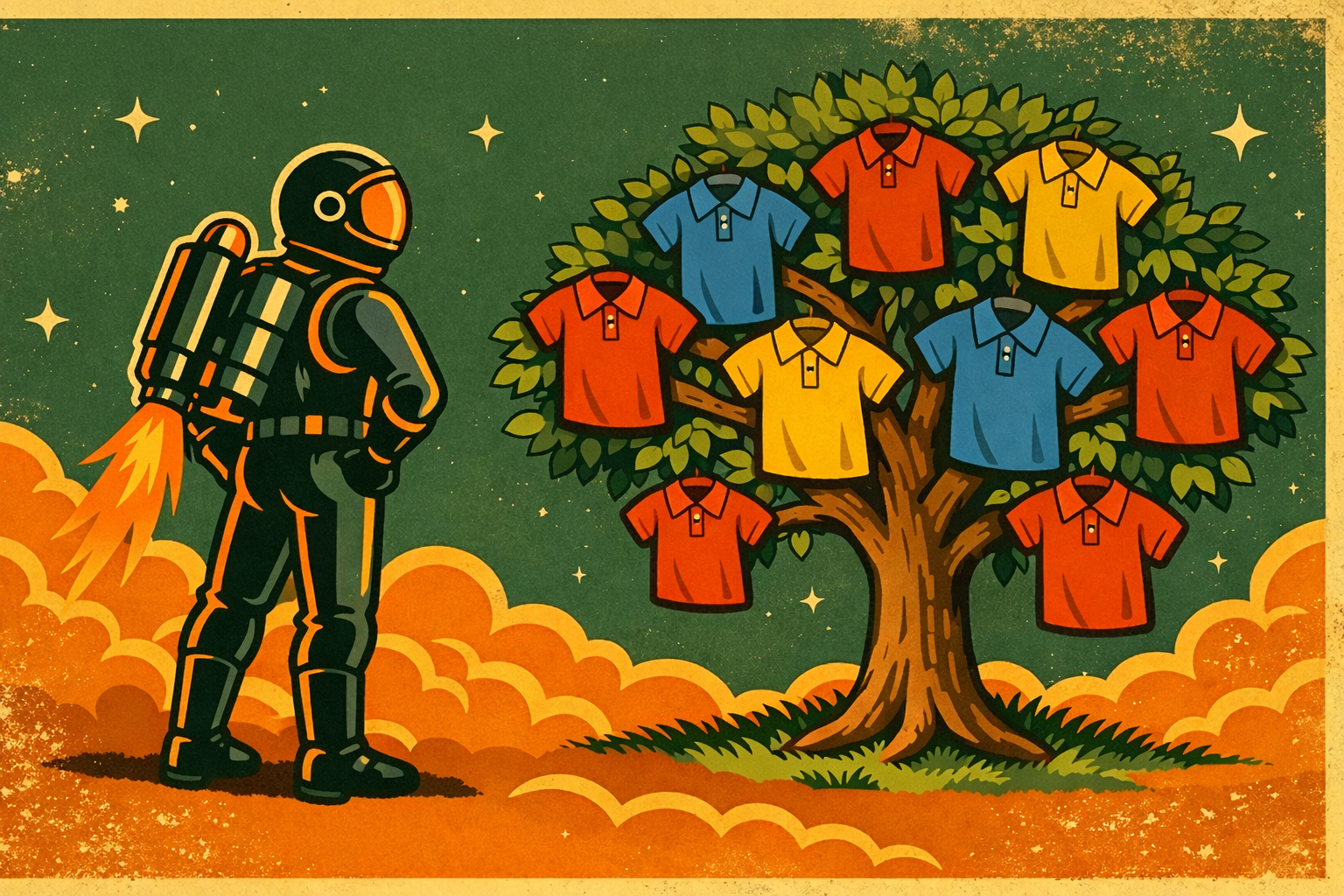
And without going out and inventing the polo shirt tree that you can grow in your backyard, what are some of the things that we can do? What are some of the simple things that aren't effectively disrupting our entire lifestyles that can make a better impact?
Alice (43:23)
Yeah, mean, one of the things we can do is first looking at what as individuals, looking at the clothing we have and really noticing and understanding what is it about this item? You know, why did I choose this? Why do I enjoy wearing it? You know, actually taking that time to think about the pieces in our lives that we use and then thinking, well, how can I extend that item's life? Or if it changed me, what's the pathway for it? How can I, how can it go somewhere else? Similarly, it's thinking very sort of strategically about if you have only, maybe it's only a few items you'll purchase in each year, how do you really make that purchase seem? Where do you want that money to go to really have the best impact it can have and really support, you know, maybe a designer or a company or whoever it might be that's doing great work? And then it's also thinking about, so for the items that I do have in my wardrobe, well, how am I extending their life? Am I learning simple repair skills, laundering them in a way that will keep them going for longer? And then it's also thinking, if I am going to be, because of course we want the expression and the creativity of something new, and that's a very human impulse. So, what are all the other ways I can acquire clothing apart from just scrolling on my phone at 3 AM and buying them online. You know, do I swap? Do I buy second-hand? Do I share with others? There's many other ways to acquire clothing and to acquire that sense of newness, I guess.
David (44:59)
Let's talk about where we are at with fashion when it comes to both now and the near future. Two words that seem to crop up a lot when I was researching for our chat was bacterial cellulose. Words I didn't tend to put together before. What role did that have in the fashion industry, both from the creation and disposal of?
Alice (45:18)
Yeah, so there's a lot of interest in new materials for clothing, ones that can be a substitute for polyester or for cotton or just, you know, they promise a different lower impact material, if you like. So bacterial cellulose is one. It's a kind of non-woven, how would you describe it? So, it's a symbiotic culture of bacteria and yeast that grows on the top of your kombucha, let's say. And then that can be harvested, and then it can be either made into a fibre, so Nanollose, which is an innovative company based in Western Australia. Nanollose have their fibre, is called Nullarbor, meaning no trees. And that bacterial cellulose is extruded into a fibre that can then be treated like a like a knit or, sorry, woven like a cotton or wool fabric, or it can be knitted. And then it can also be a substrate in that, well, it can be taken off whole as a kind of non-woven material. And then it can be used as a substitute for leather, for instance. And there's work happening there. There's also work around mycelium, like actually making new materials that are like leather from, you know, plant-based materials. And then we've got, you know, sometimes old things made new again. So, fibre can be found in many different plants. How can it be captured and remade? Yeah.
David (46:50)
This is the one that really caught my eye. I'm sorry, because as somebody who lives in the state of Queensland, we don't mind a pineapple or two. And one of the things we love about pineapples is just how soft, warm and cozy and how much I wish my underwear was made of the tops of pineapples. Nope, nope, that's not true. You looked at one particular designer who's creating fibres out of pineapple tops.
Alice (47:14)
Yeah, exactly, this is a method for pineapple plants and the leaves. Actually, if you break them open, they have long fibres within them already. And there's been many countries where making pineapple fibre cloth is a traditional approach, yeah, they've actually harvested, yeah, and they’re just a bit like linen or flax and you'd, you'd soak it and then you'd take the fibre and make a beautiful cloth out of it. So that's an old technique that can be experimented with today as well.
David (47:52)
Just a quick word on pineapple pants here, because while it's one of a variety of techniques to broaden the scope and sustainability of textiles, I still had to check it out. A few years ago, UNESCO actually added the traditional Filipino piña cloth weaving to its representative list of the intangible cultural heritage of humanity. The leaves and tops are scraped by hand, usually with a stone or these days a plate. The fibres are then combined by hand before being twisted together and then woven on hand looms to create lightweight, often sheer and silken types of cloths.
Alice (48:25)
I think what's interesting though is the new materials, it's often in terms of them gaining traction outside of a niche market, it's often about the need for scale and the need to fit in with the large scale existing infrastructure.
David (48:41)
I suppose that's the thing to follow on from that. It's all very well to have as your boutique designer creating pineapple-leaf clothing, but you're not going to get that at Kmart. Is there a role to play from even the developmental or scalable side with designers trying different techniques, different textiles?
Alice (48:59)
Yeah, absolutely. I think it's kind of thinking it's we need all these different sizes and scales. If you think about a shifting ecosystem, we need the big trees and we need the little fast ones and we need the really diversity is the key. So I think the diverse array of fibres and materials we can have the better. So, yeah, I think sometimes we see big companies investing in these new materials and that helps them just keep going and achieve a bit more scale. Perhaps our goal should not be necessarily scaling up, but scaling out, having many different kinds of local regenerative fibres that are fit for each region.
David (49:40)
You mentioned the idea of growing or creating textiles or creating material for the textile. I understand even part of the course that you were teaching for a while, first years, had to make or had to grow their own clothes, again, without the benefit of my polo-shirt tree that I have in the backyard.
Alice (49:56)
That's right, that was a project we ran for some years actually, probably about 10 years ago. And it was a fantastic design studio where the students would grow that SCOBY as I described and then harvest it and make things from it. And it really did get you thinking, well, we have a very linear way of thinking about how fashion's produced. You grow the fibre, you make the cloth and then you cut it out and so on. But with this method, you could actually make containers in the shape of the pattern piece, grow the pattern piece to size. And so the students, did really inventive things. Like one made a tray in the shape of a collar and had a kind of embossed shape in it. And then you grew your own collar with the decorative embossing using the materials. So yeah, and I think it's that kind of thinking.
David (50:45)
Kind of like the Japanese watermelons, Japanese square cube watermelons or things like that.
Alice (50:49)
Yes, exactly. That's right. That's right. So, it's, I think there's a lot of benefit in, it's not as if all of these innovations have to be scaled by any means. It's more that what thinking do they provoke and how do they allow us to see different ways of fashioning ourselves.
David (51:06)
Professor Alice Payne is our guest on Where Are We At with Fashion? We're talking about some really interesting future moments, developments that are happening right now and possibly into the future. She is the Dean of Fashion and Textiles at RMIT. Some of your work and what I'm struck by reading through some of the papers you've co-authored is the variety of colleagues and disciplines that you've worked with when it comes to looking at fashion, both from a legal perspective, from an engineering perspective, whether it's working out how to teach a robot to take buttons off for recycling, or the title of the paper that I would never expect to see. I have to read it out because I'm not a science person. “Multi-heteroatom doped nanocarbons for high performance double carbon potassium ion capacitor”. Now, I know what at least four words of that mean. How does it end up with my jeans charging my phone. What's that all about?
Alice (52:00)
Yeah, so that was an outcome of a project where taking textile waste and then using a pyrolysis method to turn it into potassium and then making the potassium into these supercapacitors, which are like a kind of battery, and actually just seeing if all of those could work. And it was led by physicists, so it's well out of my understanding. I had a very small part in the project in terms of, you know, connecting the industry partners, actually characterizing and looking at the textile waste that could then be go through this transformation process. But to your larger point, one thing that I found probably the most rewarding thing of my research career has been collaborating with different disciplines. So, yes, as well as people from physics, from biotechnology has been incredible and from law, from business, from film and interactive design. I guess every, because we got such a multifaceted problem with fashion, me as a trained fashion designer, I'm not going to be inventing the new materials. I'm not necessarily going to be writing the new laws. However, what I can bring is an understanding of a whole system way of thinking and understanding the potential intervention points that with different disciplines we can explore.
David (53:28)
You're right, it is incredibly almost endlessly complex industry, both from the challenges, the outputs, the solutions, and as a result, it really should be a cross-disciplinary study with a lot of people involved. I'm struck by reading your work as well as a few others in the fashion industry, which approached one aspect that I certainly have never considered, which is almost a more metaphysical or spiritual aspect, our relationship when it comes to fashion, clothing, kinship as it were. Tell me more about that.
Alice (53:59)
I suppose that idea comes from the work of Donna Haraway, who talks about us staying with the trouble, if you like, of this kind of complex, inherently unsustainable human world we've created that's always separate from the natural world on which it depends. And so, she and many other thinkers like her, and these are old ideas, of course, they're kind of saying, well, how do we really reposition ourselves as being in kinship with the living world, entangled with it because we actually are. We're just pretending that we're not. We're kind of almost pretending we're somehow separate. So, this idea of kinship was if you see your garments as part of this continuum, just as yourself is an organism in time, you know, and then will also dissipate as well. So, your clothes and the materials around you are also something you're in relation with and we have a kind of kinship with all the hands that made our garments all the way through, the soil they came from, the fibres they're grown from, and then where they go at the end as well. So really, I suppose, it is kind of metaphysical. But maybe it's also just how it is. I mean, I am wearing the output of a silkworm and a cotton. And I'm this kind of complex hybrid or assemblage myself. So, what does it do if we actually accept that and really enact that in our lives? And I don't really know. I guess it's just important to keep in mind and not somehow think that these garments flow in and out and away they go. Yeah, we're all in it together.
David (55:41)
I love the idea of somebody listening to this right now and perhaps looking down or in the mirror at what they're wearing and think, how does my Bart Simpson “Eat my shorts” t-shirt fits metaphysically as well as pragmatically and the fact that they both are present in both complexity and simplicity. Finally, today I wanted to ask you about fashion future. You of course have written a book, quite literally “Designing Fashion’s Future”.
Alice (55:48)
Yeah
David (56:03)
I'm not asking you to tell us what's on the runway next week, next year, anything like that. What are some of the things we will be seeing when it comes to both influences as well as changes in coming years, decades?
Alice (56:17)
I suppose I can't help but think, and maybe many listeners also think this, when we look at the world and we see the shifts coming in climate, we're seeing the responses of world leaders, it really feels like there's a sort of inflection point at present where the world that we accepted as, this is the world we're going in, and it's always like progress, progress, the next technology and so on, we're kind of seeing all that cracking and it also whose benefit is it really for? And I think that when you see all the A-I tech bros, you kind of see, OK, the world we were promised, if you like, the modernity, the progress, that's crumbling. And in a future where we're going to be faced with increasingly volatile climate, supply chains will be disrupted. There really is no choice but to look local, look to ourselves and our communities and go, well, what is a good life in this world? And if the large scale systems we've relied on start to crackle and crumble, what then for how we live and how we structure our economies? And I can't help but feel that the very constraints that we face as a world will mean that we are forced to rethink that. And we've known for a while we need to rethink it. And I say we as in, you know, all of humanity has probably known that things are cracking and crumbling. So, we've known that for a while but I think real physical constraints will hit and I think we'll through necessity, we'll have to adapt. So that's a very broad-brush way of saying that our economies change as a result. And by extension, the way we clothe and fashion and express ourselves changes as well.
David (58:12)
So whether we have a collar, whether we have a ruff, whether we wear tights or not, there will be a difference in both the look of the clothes, but also the very life cycle, very nature of it at its heart when it comes to both its development, design, creation, and ultimately disposal.
Alice (58:22)
Exactly. That's right, and to think that a lack of material abundance will not mean a lack of creative abundance. If anything, we'll continue to have incredible expressive fashion system. It's just that one that will be smaller in material terms. Yeah.
David (58:48)
Professor Alice Payne, thank you so much for your time today.
Alice (58:51)
Thank you, David.
David (58:58)
And thanks again to Professor Alice Payne from RMIT. You can check out some of her articles and related information on our website, as well as that “Good On You” app for getting a better idea of what particular brands and retailers are doing about fast fashion and how workers and the environment are considered in their decisions. Either click on the link in your podcast app or you can head to www.wawawpod.com, that's www.wawawpod.com.
Next time, do you speak my language? Who needs the translating “BabelFish” from the Hitchhiker's Guide to the Galaxy or the 6 million Languages by C3PO from Star Wars when you can pull up an AI translator on your phone?
Professor Marc Orlando, Macquarie University (59:42)
If you are in a high risk, a medical appointment and you are making very important decisions on that. Are you really giving that to a machine interpreter? I'm not too sure. Or will you really trust the thing? If it's a legal document that needs to be translated, but that's extremely sensitive and there's a high risk to that, are you going to do that? I think low risk is fine. High risk is definitely something that people should consider if they want to use technology. The problem is that when do you move from low risk to high risk? And how do you define that as well?
David (1:00:13)
Okay, so maybe ordering from the menu using the app is fine, but what if you have a hard to translate allergy or you're arrested in a foreign country? And what's the difference between a translator and an interpreter? There is one. Find out next time on “Where Are We At With Universal Translators?” Music for the show is by Michael Willimott, production assistance and design from Claire McMillan, Annie Pappalardo and Grace Curnow. I'm David Curnow. Goodbye.

Dean, School of Fashion and Textiles, RMIT
Dr Alice Payne is a Professor and Dean of the School of Fashion and Textiles at RMIT. Her research focuses on environmental and social sustainability issues throughout the life cycle of clothing. Recent work has examined labour issues in the cotton value chain, as well as technologies to address the problem of textile waste. She is author of the book Designing Fashion’s Future, co-editor of Global Perspectives on Sustainable Fashion, and is an award-winning designer and educator.