Where Are We At With Universal Translators?
Apps like Google or Microsoft Translate claim to have removed the language barrier. But few people would trust an app to interpret their complex medical history, or relay critical information in a court case. Human translators and interpreters have formed critical links between civilisations and thinkers for millennia. Professor Marc Orlando from Macquarie University tells us where things can still get lost in translation.


Research paper about the impact of digital technologies on Translation and Interpreting industry
In case you haven't ever come across the surreal, magical world of Douglas Adams' "The Hitchhiker's Guide to the Galaxy", you can get the audio here. "In the beginning the universe was created. This made a lot of people very unhappy and has widely been regarded as a bad move."
"The Hitchhiker's Guide to the Galaxy" on Audible
David (00:09)
Communication has helped homo sapiens develop into the dominant species on earth. Complex details, histories and technologies passed on through generations. But we don't all speak the same language. Nearly all cultures have origin stories for the different languages, from the Christian Bible explaining that when humans built a tower to try to reach God and he wasn't in the mood for visitors, he split everyone up into different language groups. Or Northern Australia's Kunwinjku people, who describe the mother creator giving all her children a land and a language of their own. Hello, welcome to “Where Are We At With?”, the podcast looking at the promises of the future made in the past. I'm your host, David Curnow. In books and movies, the action often occurs in other galaxies. The challenge of talking to another species is often solved with a device that acts as an interpreter. In Star Trek, it was a universal translator. In Star Wars, it was a shiny gold robot.
Clip from “Return of the Jedi”
Do you understand what they’re saying? Master Luke, I am fluent in over 6 million forms of communication. Well what are you telling them?
If those aren't the droids you're looking for, how about Douglas Adams' "The Hitchhiker's Guide to the Galaxy", where a fish did the job. The Babel Fish, in fact, which is inserted into the user's ear canal.
Clip from “The Hitchhiker’s Guide to the Galaxy”
Ford, why do I have this fish in my ear? It’s translating for you. It’s all in the book, under Babelfish”
This remarkably niche fish feeds on brainwaves and it excretes a telepathic matrix.
Clip from “The Hitchhiker’s Guide to the Galaxy”
The practical upshot of which is that you can understand what anyone is saying to you in any language
Isn't evolution amazing? But of course on a planet without such a creature, for years we've relied on people who can speak more than one language to interpret for us.
Clip from “Lost in Translation”
(Japanese being spoken) He says, with intensity. Is that all he said? It seems like he was saying a lot more than that.
Times, however, they are a-changin'. Maybe it's an app on your phone, AI like ChatGPT, or Google or Microsoft Translate.
David (02:31)
Where are we at with universal translators?
(In Spanish) Where are the universal translators?
David (02:40)
Gracias. But recently the action happens even more directly. Smart glasses translating straight to your ears.
Clip from Ray-Ban Meta demonstration video
Today I’ll be cooking in Spanish. Meta activate translation. Chef, what dish are we cooking today? (In Spanish) We will be cooking a traditional Guatemalan meal.
One might think that this technology does away with translators and interpreters at places like the UN, courts, hospitals, foreign government meetings, etc. Right? Well, hold on to your English-speaking horses. After all, sometimes technology is fallible.
Clip from “Galaxy Quest”
What’s the matter with her, doesn’t she talk? Her Translator is broken. (High pitched Thermian gabbling) Okey dokey then.
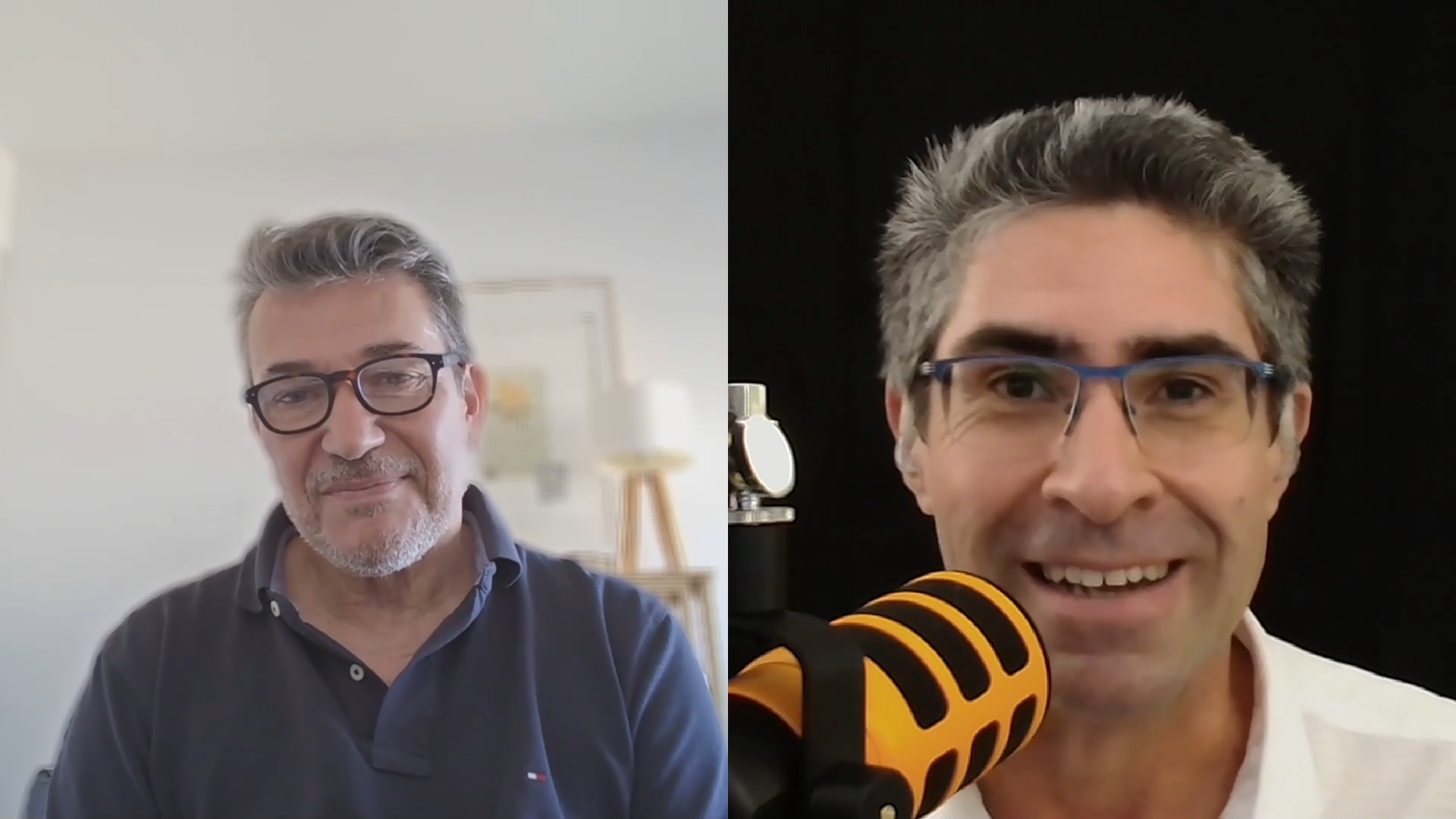
Professor Marc Orlando is the director of the Translation and Interpreting Program in the Linguistics Department of Macquarie University. He's also the vice president of the International Association of Facilities that Teach Translation and Interpreting, or TI for short. He spent many years as a professional in the field, often actually in the booth, hearing what is said by one person and simultaneously relaying that in another language for one or more listeners. He's also spent quite a lot of time researching the effect of new technologies on his field.
And he's our guest today on Where Are We At with Universal Translators.
(In Mandarin) How the translator?
David (04:08)
Shush you.
David Curnow (04:14)
Professor Marc Orlando, thank you so much for joining me today.
Marc Orlando (04:17)
Thanks for having me.
David (04:19)
First of all, a little bit of a sneaky question here. Do you have a translation app on your phone?
MO (04:25)
I actually do, because I travel in countries where I do not know the languages at all. And I must admit that being on a taxi, speaking with a Chinese taxi driver can be quite challenging when they don't know anything about English. Same thing in Japan recently. So yeah, yeah, yeah, why not?
David (04:45)
Okay, we're not cheating on any of your colleagues. That's good to hear. How does Australia compare to other countries when it comes to speaking or understanding different languages?
MO (04:47)
Well, that's an interesting question. think, I mean, as you know, and as we all know, Australia is a very multi-cultural society, you know, that grew on migration and is enriched every year on migration, despite some of the things we can hear in the news from time to time. Sorry about that. But remains quite monolingual in terms of the mainstream. And even if we have, you know, I think every time we survey people, know that about 20 % or 25 % of families speak another language and English at home. Despite that, mainstream Australia is extremely monolingual. So it's an interesting country in the sense it's multi-cultural but very monolingual. And I mean, there are very clear reasons for that, know, no language, no second language compulsory in any of the curricula, in any of the curricula, neither primary school nor secondary school. And that's a big, difference with Europe in particular, or even with the Americas, know, mean, Latin America in particular, yes, it's because English is the lingua franca, but it's also because there's this need to make sure people can communicate in different countries, in different languages and get closer probably to the people they visit. I was reading in anticipation to this conversation, I was reading a note from the EU from 2025 or from 2023 in regards to 2025 and the programs they have developed over the last few years were about having every European young person speaking at least two foreign languages by 2025. So they started that I think it was around 2010. Not too sure it's the case, but at least you have programs in place that allow this. Australia does very little.
David (06:48)
Yeah. So an aspirational goal, which is fantastic and can only involve people communicating better. I think a lot of Australians, if they do travel overseas, are sometimes struck by the fact that things like signs, they'll often be at least two languages, if not more, for those who are in the area.
MO (07:04)
But interestingly as well, we hear Europeans say it's because of what Europe is and within an hour you're in another country in another language. But I think here in our region, even if it's after five or eight hours flight, we have very interesting neighbours that it would be good to know the language of when you want to communicate with them. Indonesia, Malaysia, Japan, China, I we need these partners and we need these things. So think it's definitely something that is... unfortunately not a priority in Australia.
David (07:36)
Maybe in the future, here's hoping. When we first began emailing, I was discussing the idea of Where Are We At With Translation and I suppose the idea of neural implants, the Babel fish, the ability to universally translate. And you replied to me, said, would you prefer to speak about interpreting or translating? The fact that I didn't know there was a difference, we've got to start with that. Explain to us just a little bit about the difference between translating and interpreting.
MO (08:03)
Yeah, it's an interesting point. And I hear that, like you probably nearly every day in the news, people are always referring to translators when they mean interpreters and sometimes vice versa, but not vice versa. It's generally translators seem to be, if you want, the umbrella term for both translators and interpreters. it would be definitely more correct to say translators and interpreters. So the big difference is the source and the input and the output, if you want, of what you're doing. So in translation, it's written source and written targets, so the input and the output is in the written form. In interpreting, it's in the verbal form. It's about something you hear, it's about something you speak about and you reformulate verbally or sometimes in signed because it's also signed language, not only spoken languages. The big difference is that there are actually two different jobs, know, they require different skills, they require different training, sometimes and specifically with interpreting, they require different abilities as well. And we might speak about cognitive abilities and things when it's about interpreting. And so, I think the immediacy in interpreting makes it very specific. The fact in translation that you can go back to the text as many times as you want, can undertake the research that you want when you work with a text, know, makes it a very different task, for sure.
David (09:26)
And is there a difference in, I suppose, targeted accuracy?
MO (09:30)
Yes, I think with translation you can be sometimes very literal. If a literal translation works, why not? You would keep that. You can also be quite free. If there are no specific word equivalents, you will try to work at the level of the meaning and of the effect sometimes. In interpreting, it's rarely at the level of words. Of course, the languages are the tools that we use, but it's all about, OK, what is this person trying to say? How am I going to reformulate this in the other language? It's all about the intended meaning of the utterance and the speaker. It's about the ideas that you convey. So generally, we tend to discard actually the words. And this is the way we train students when they start being trained as interpreters. You tell them, OK, forget the words. The words help you to understand what this person is trying to say. But you have to discard the words as such. What are they saying? How do you want to cloth that in another language? How do you want to express that the more naturally possible with the right words for the right person, depending on their age as well? So your target audience can be different. Your target culture can be different for the same language sometimes. So there are all these elements. And the immediacy of interpreting makes it actually, know, the processing goes fast. You have to get that output very quickly. So it's better not to be distracted by words per se, because when you start to look for an equivalent, unless when you really need very specialized vocab and you try to, of course, prepare for that and you try to have your glossaries with the right words. Beyond that, it's generally with interpreting, it's generally more these ideas that you need to cloth in another way.
David (11:14)
Not many people would say to themselves, I'm going to be an interpreter. Don't concentrate on the words, concentrate on the meaning. That's amazing.
MO (11:20)
Yes, I mean, yeah, I agree. I mean, you will probably hear me say that quite a few times. We often say both for translation and for interpreting, but for interpreting, think it takes a different shape that the languages aren't just, as I said before, the tools, they're the vehicles that you use. What is important is how you organise that and how you do that, how you perform that reformulation and what you need to perform well in that reformulation.
David (11:50)
We'll get onto some of the mental gymnastics that are required when it comes to particularly interpreting it a little bit. First of all, though, I think most people listening to this will have English as their first language to anyone who doesn't. Hello. Great to have you. And those people can probably just tell that you're not originally from around here, so to speak. English isn't your first language. Where are you from? And when did your interest in languages begin?
MO (12:14)
So I'm originally from France. So I was born in France and educated in France and yeah, learnt English like most young Europeans when you start high school, generally from the age of 12. In my case, I had two older sisters, so they had started English in high school before me. And so one of them was quite bossy. I remember well, she was making us repeat the words I think. So probably from the age of nine, eight, nine, 10, I was already saying a few words and a few things in English. And at the time in France, you also had to learn a second language. I think it's still the case. Still, I had to learn a second language two or three years later. So from the age of 12, officially, at school, I learned English and I German from the age of 14.
David (12:58)
Yeah. So effectively you're learning it's two other languages so that you have three. So not just, not just bilingual, but trilingual briefly. There is sometimes a feeling around the world of resentment towards English, partly because of those who speak it often expect others to speak it. Did you ever feel that or sense that in others in your area?
MO (13:04)
Not really. think what you hear is generally when English speaking tourists go somewhere, people can be quite resentful. mean, we've heard this a lot about France and about the fact that Parisians in particular are really, really, really resentful to those who do not even try. I think it has changed with the Olympic Games last time. think there were clear messages about not making tourists not welcome, even if they didn't speak a word of French. But I think, I mean, yeah, I can understand. I've never personally really felt that. It's just, think, once again, I think it's just simply a pity that people do not learn. And sometimes the basics, just a, you know, hello, goodbye, thank you, please. And, you know, just that will definitely, you know, this is the three, four words I know in Chinese are exactly that. But when I, again, once again, when I get in that cab in Shanghai, I can at least say hello, I can at least say goodbye, can at least say thank you. And I think they appreciate it.
David (14:15)
That goes a long way, absolutely, if you can just have those basics. You've learnt two other languages and became relatively skilled in both of those, even at high school. What drew you then to taking it beyond that to the idea of interpreting or translating?
MO (14:29)
Well, mean, in my case, was not part of really a thought process or whatever. I studied English studies at university after high school and my majors were in linguistics translation and American fiction was what I was doing at the time. I was working on American postmodernism, know, that was my thesis at master's level. But anyway, it's after that I started teaching English in France for a few years, and in that role, I was working specifically with young athletes that I was teaching English to so that they could use English in press conferences and different things. So I ended up having a sort of go-between role that was quite interesting, which was not only about being an English teacher, but I was not really interpreting and I was not really trained as an interpreter. I was trained as a translator, but not as an interpreter originally. And then for personal reasons, my wife and I and our three kids moved to New Zealand after that, where I would not teach English there as a French person moving to New Zealand. So I started after once the family was well settled, I started looking at different other things to do and opportunities using the languages that I had and definitely translation and interpreting in particular at that time. So that was 22 years ago, the languages I had could be used in translation and interpreting. I undertook more training. I sat tests because we are the only country Australia with, and that was the case in New Zealand, with a certification authority, an accreditation authority for translators and interpreters. So I sat the tests that were offered by this accreditation authority and was successful and then started working right away actually for the French Embassy in New Zealand and then for a few visitors coming from, you know, the French parliament and whatever. then, yeah, there has this history. One conference led to another, and then I became a conference interpreter, which is mainly what I do now when I'm not at uni.
David (16:29)
It's an amazing path if you think about starting out in Bordeaux and then suddenly we're in New Zealand translating for embassies in Australia, teaching Monash, Macquarie, Antarctic divisions, all this sort of thing. We look forward to getting to this. The idea of languages and the fact that there are different ones occurs in a lot of different cultures. When you look at origin stories, whether it's the Christian Bible, whether it's Africa, parts of South America, even First Nations Australians have tales of why people spoke different languages. One thing in common in those, feel often, is that when people speak the same language, they were happy, but then at some point they are split up into different languages and they're not as happy. Is that fair? Do you think the world would be better if everybody spoke the same language?
MO (17:17)
It's an interesting one Would the world be better? I mean, in some areas, I'm pretty sure things would be easier. mean, there would probably be a sense of unity somewhere. There probably would be easier conversations to be had when, I don't know, at the level of the economies, at the level of international trade, maybe. I interpret in some meetings where sometimes you can really realise that the difficulty is not only about the topic they are they are discussing and disagreeing about, sometimes it's also about the difficulty to make yourself understand.
David (17:52)
Okay, just quickly interrupting here. The idea of a universal language spoken by everyone isn't just confined to origin myths like the Bible's Tower of Babel. Many people will know about Esperanto. Invented in 1887 by Ludwig Lazarus Zamenhof from what is now Poland, he was hoping to create an easy and flexible language that would serve as a universal second tongue, fostering world peace and international understanding. Today, there are about 100,000 speakers in the world, including here in Australia.
Clip from Australian Esperanto Association
(Speaking Esperanto) Erika, where did you say you will be going for holiday this year? Hobart. Oh how nice, it’s lovely there.
Esperanto, Oz-style. World peace though? Work in progress.
MO (18:34)
So, maybe one language would help in that sense, but at the same time, I mean, we would lose so much, we would don't we need diversity, don't we need a more colourful world, you know, we know that languages and cultures are extremely tied and, you know, even one language spoken in different parts of the world is tied to different cultures and different ways of seeing the world and in our conversation earlier I told you that Federico Fellini, the Italian filmmaker said one day that another language is another vision of life and another vision of the world and I think it is very interesting to keep that in mind. We enrich ourselves simply being around other people who think differently and that goes with languages I think, that goes with cultures and languages and I think it would probably be quite a monochrome world if we were not as colourful as we would say. I think I remember as well one quotation that I use often when I'm asked by people was one from Nelson Mandela who said to people one day, when you speak to a person in a language they understand, that goes to their head. If you speak to them in their language, that goes to their heart. So that notion as well of being able to speak with someone more at the heart level is probably what you want. And I think even in some very heated debates at diplomatic level, whatever, can see that if people can speak in their language, that may make a big difference. And I think this is where the role of translators and interpreters is quite interesting.
David (20:12)
Are there concepts then or emotions that perhaps are best expressed in certain languages? We often hear the story and correct me about this one as a native speaker, but that the French is the language of love, ? that German is the language of engineering or something like that. And of course that is from people who are not speaking either of those languages quite often. Do you think there are some concepts or ideas that are best portrayed or best couched in some languages?
MO (20:29)
I would say yes. I don't know if they are best expressed in other languages or in some languages and in some countries. Maybe not best, but probably different and they mean different things. We hear that sometimes there's a lot of lexical borrowing from English in particular in some languages because some concepts, some words do not really exist. The words to convey exactly that meaning doesn't really exist. So I think that might be, yes, sometimes this concept, but I also know, and I've also noticed that in something that we call localisation, localisation is a big thing today in marketing and in, you know, it can be software localisation, can be games localisation, can be marketing localisation where you want to sell your product in a very specific culture, in a very specific market, and you have to adapt it. That goes beyond language, of course, that really ties to culture. And I remember one example years ago about an ad for a male, a man, a man's perfume. And the colour black was used in that ad. I think it was Harmony or whatever that was. There was a lot of black and that was very sensual. And I remember someone saying, oh, in Latvia, black is only associated to death and mourning and things. You would not have that ad at all. You would have to have a complete different ad. So I think these concepts are quite interesting, you know, that you, you can express things different ways, even if Black seems to be the same thing for everyone, actually it's not. So yeah, it's French a language of love, I'm not too sure. Probably poetry has helped in that and probably history has helped in that, yeah, what I know, for example, I know English and French quite well and I work with both and for many years now, I think French has a different musicality and that's what people tend to say and a nicer musicality than English. Though as a non-English native speaker I like as well the intonation and the music of English. So actually I think it depends but yeah somehow yeah would say yes.
David (22:41)
One thing that struck me speaking to both you and other people recently who are multilingual, particularly those who are idiomatic fluent in a number of different languages, they say that they almost have a different personality in different languages. Is English speaking Professor Orlando different to French speaking Professor Orlando?
MO (22:59)
I think Professor Orlando doesn't speak much in French because Professor Orlando is an academic who speaks in English in an English university. But is Marc Orlando different in English and French? I'd say yes. I think, I try to think about a few examples. I think I'm way more relaxed since I've been living in New Zealand and in Australia. think I was probably more tense in the past. So maybe because I was younger, maybe simply because it was the French thing. I don't know. I'm probably more direct in French, but also it may not be the language, probably more the culture, French and probably, you know, Latin languages, or if you look at Italians, we're very direct. Saying no is not a problem. I will tell you no to your face. know, Australians, Kiwis, and probably British as well, do not say no, even when they think no, they tend to say ye , so it's not...
David (23:58)
Or worse they say, yeah, nah.
MO
Exactly. So you have to adapt to that. So I think I have, yeah, I think I'm probably more relaxed when I speak English. Some people say sometimes you're funnier in a language than another. Humour is an interesting thing, you know, with language and idioms and humour are things we all often talk about, about interpreting and translation. So, yeah, I'm probably a bit different in, but you know, probably, you should probably ask other people than me.
David (interrupting) (24:31)
Ask your family.
MO
But I think French is more formal as well. This is where I would get it's more direct, but it's also more formal. So I think we tend to be to be way less formal in Australia than in France for sure. So the language, of course, conveys that surely.
David
Professor Marc Orlando is our guest on “Where Are We At With?”. This week looking at where are we at with translation, the Babel Fish perhaps, some sort of universal translator from Star Trek or C3PO from Star Wars, who knows. We are discussing some of the roles of translating and interpreting. He is the director of the Translation and Interpretation, Interpreting Program, sorry, at Macquarie University. Let's talk about the idea of one language hearing and repeating it back in another language. We've discussed the fact that mentally it can be challenging. What are some of the biggest challenges when it comes to that process of interpreting?
MO (25:27)
So first of all, it's not repeating. And that's the thing. We are not repeating the thing. As I said before, that would be at the level of words if you were repeating. And so when you are interpreting, and here we are talking a bit about simultaneous interpreting, which is one of the two modes of interpreting, you are indeed listening to an input, the process, if you want, is that you're listening to that input, you're processing, you're analysing what is being said, and you are, while you're still listening and start speaking a few seconds later, there's generally a few second gap or lag, you are the time to process and to memorize some other things and reformulate and then you are reformulating. So cognitively people are quite impressed when they see of course someone listening in one language, speaking in another language. So one thing is that there's of course a slight delay, which is the delay where you discard the words, as I said before, you process what this person is saying and you're conveying the same meaning. What is not visible and that is very interesting and some people are surprised with that when I say that to them is actually the most difficult thing is also to monitor your own output. So there are two lines of discourse that you are always listening to when you are interpreting simultaneously. You're listening to the input, you're processing, you're reformulating, but at the same time you keep an ear, if I can say that this way, on your own output to make sure that you finish your sentence, you're not too fast, you are making sense and so there's this very complex and multi-modal, if you want, way of doing what we're doing. So yeah, it's cognitively extremely demanding. It's extremely tiring. And this is why simultaneous interpreters, as you see them in booths, in international meetings, are always two, if not three, and swapping every 30 minutes to make sure that you can rest, but also to make sure that you keep unit quality of your interpretation very high. So yeah, I mean, it's an interesting process. When we start, I you can do that next time you listen to a radio program or whatever, we start training interpreters sometimes on that concept of listening and speaking. We often ask them to do that, what we call shadowing, just in the same language, just simply do some sort of what we call phonemic shadowing. You just simply repeat exactly what the speaker is saying, but exactly. So that means you have to really focus and be very active, listening actively to make sure you can get all the words. But you cannot generally repeat them if you don't understand them. I you can, but it becomes more phonemic than... So it's an interesting exercise. And little by little, we ask them to adjust that shadowing to take a few seconds, you know, back or to be back a few seconds later after the speaker, that's all of things. You can do that non-lingually.
David (28:21)
I will admit to being slightly nerdy and of course as a former newsreader I do that occasionally when I'm listening in the car or something like that. I'll repeat back what the reader is saying in the way that I would say it if I felt that it wasn't perhaps being read for meaning as well as it could have been. And it is challenging because you're right, you are monitoring what's coming out of this part while also listening to what's coming in here and making sure you're getting it right. I'm just doing it in English and it's hard enough.
MO (28:49)
That's interesting because you're doing interpreting if you are trying if you are changing the way people are saying things because you would say it you think it would be said better that way you are actually doing what we do as interpreters we're simply trying as I said before to find the right way in that language in your case it's in the same language but the best way to convey that idea because you're focusing on the ideas more than the words and that's exactly that so you're your material for training if you had another language.
David (29:12)
I don't think there's too much market for English to English translation that goes on.
MO (29:19)
Well, I mean we were talking about localisation before. There are quite a few things that are done between Australia and the US, for example. I remember a novelist saying that she had to change her novel when it was published in the US because there were some concepts that the Americans didn't want to see in the book. I remember hearing people saying that when the very first Mad Max was released in the US, it was subtitled into American English because there were things in the original movie that Americans would not get. So there you go.
David (29:50)
Quick interruption here, some Australians may also remember that there had to be a different version of The Castle to explain some of our delicacies.
Clip from The Castle
This is beautiful, what do you call these again love? Rissoles. Everyone cooks rissoles. Yeah but it’s what you do with them.
Yes, Rissoles became meatloaf, caravan became mobile home, and “Hey Hey It's Saturday” became “Funniest Home Videos”.
David (30:14)
Have you ever looked back at an interpretation session and thought, I don't know if I got that quite right?
MO (30:21)
Yeah, think, I mean, not necessarily thinking back. Generally you realise while you're interpreting that you are, I mean, if we go into the details of what's happening, there's a lot of anticipation in what we do because there's a lot of preparation ahead of a meeting generally. So yeah, sometimes you anticipate a little bit too much and then you finish the sentence or you go in that direction, knowing the stance of the speaker or knowing where the discussion is going and you realise that, but actually no. So you can just simply get back on track. Sometimes you simply make a mistake and then you simply correct yourself. I would say a correction from the interpreter was actually blah, blah, blah. And I mean, your listeners, the audience, the delegates listening to you would actually appreciate that. That's for them a sort of sense of professionalism here and something that is probably needed. People would think, my God, I made a mistake. I will not say it. Yeah, no, I think there are things we do, you know, consciously. There are omissions that we, know, there are conscious omissions because what is being said is useless in the discussion. So again, it's not word for word. So, but sometimes, yeah, you will make a decision and you will realise that actually, you know, it's probably better to rectify that or to correct that. Yeah.
David (31:42)
And when we discuss omissions or perhaps understanding of perhaps the stance of a particular speaker or the topic itself, are there times when you might disagree, you might be confronted by what's being spoken about? What does an interpreter need to focus on in those situations?
MO (31:59)
That's interesting. think, I mean, you definitely need to let your own ideas and your personal views on these things out of the booth or out of the meeting room, if it is what it is. But you're right, there are areas of work where definitely it is difficult and there's something that we call vicarious trauma for interpreters. know, there's a lot of work being done around that to make sure interpreters are well assisted and well supported. My very first thing would be do not accept the job as an interpreter if you don't think you can do it. But if you think of war zones and natural disaster areas, if you think of war trials and tribunals, if you think of some medical settings sometimes where you have to discuss very difficult things with the patient. So if you do not have that sort of professional persona, that is not the you, that's you as an interpreter, then that could be a problem indeed. Then there would be things in meetings where people will say things in a certain way. Things, it's our role to generally convey the tone. It's our role to convey exactly what they're saying in terms of the meaning and what they... So, yeah, you normally have simply to see, even if you disagree with the speaker, you simply have to not let that influence what you're saying. We hear sometimes that interpreters can sometimes tone down a little bit what's happening specifically when you work with people who there's a very specific objective for the meeting and because you've been recruited by them you know they've they gave you a sort of brief of what they want to achieve and if someone is just simply I don't know losing it in the middle of a meeting maybe you're not going to say exactly what they're saying just to make sure you you know what they're while trying to achieve so maybe you will control that but normally you're not supposed to mean, the agency is limited. You don't want to be the conduit just simply being a conduit. There's a role to play, of course, but there's also an expectation on conveying what has been said and the right way.
David (34:07)
And what sort of people want to be interpreters and translators? Are there particular types? Is there a certain path? Yours was a bit of a windy path. Is it the same for most people?
MO (34:17)
Yeah, think what many people who work in in study languages and language studies very often are offered the possibility to be trained as interpreters and translators. I would say 50 years ago, training opportunities were way more limited. So many interpreters ? came to the profession just because they had been exposed when they were younger to different languages. Their parents may have lived in different countries or whatever. Sometimes people come from very different industries. know, would have people after a few years in that job or that job because they have a language pair that they master quite well. They will be trained or they will jump into it like that. I would say, I know we're going to talk about technology at some stage. We have fewer and fewer people enrolling in translation and interpreting courses, which is quite concerning in some ways. But I can understand, know, when you're 20 today and you speak two languages, do you really think there is a future for that? So who is becoming an interpreter or translator today would probably be very different to what it was 40 years ago or 20 years ago. But yeah, I think you meet people from all walks of life and people who came to that very late because of this or that thing in their lives or sometimes people train as lawyers will after a few years at the bar will decide that, you know what, I don't want to that anymore. And because for whatever reason, they speak two or three languages, they move into translation and interpreting. I've seen the same with people from the medical industry, journalists, quite many of them. But we've seen other things as well. I've seen someone who was working as a UN interpreter became a diplomat and became an ambassador somewhere because we are also very used to to that sort of of environments. And so, so, it can also go the other way around, going to other professions from translation and interpreting.
David (36:07)
Not to project too much of my own thoughts here but it's interesting how that parallels when it comes to journalism and the media and the idea of speaking to so many different people that in the end you just want to keep doing what they're doing or speaking to those people because of the environment you're involved in. You mentioned a little bit earlier about the idea of presupposing or anticipating as a result of your knowledge of either the person and or the topic. How much about the topic do you need to know and do you then I suppose end up specialising in interpreting in those particular fields.
MO (36:38)
So a very, very straightforward answer to that is that an interpreter, I mean, again, the translator, that's different because you go back to the text as much as you want and you can, unless you are under time pressure, but when you're not, and generally you're not that much under time pressure, you have time to post edit, you have time to review. In interpreting, the rule is really provide as much information as possible to the interpreter before the meeting. Briefing them is good. Well, I'm lucky, my main job is to work at university so I can choose the interpreting jobs that I do. And I'm lucky to work for organizations that provide us with documents and the documents of the meeting. So we will read the same documents weeks ahead, days ahead, like the delegates. You become one of them because you know what all the documents are about. You do not know how they are going to deal with these documents and where, and again, even still, you can anticipate if you've been following these meetings from years, you know that that and that and that country will probably go for that sort of objective or outcome of the meeting. These group of countries will try to obtain that and to get that. So you can really anticipate that sort of. So that's at that level. The stance help you. But then during the meeting, yes, of course, you create glossaries, you create all this so that you have all the technical words and you understand exactly what you're talking about. So preparation is probably, if not 50%, I mean, at least 50 % needed for quality interpretation. And then the fact that you are a trained interpreter and that you are good with your linguistic skills and you are pleasant to listen to and that sort of stuff works as well. But preparation is essential. But preparation, it's not about a list of words. I often say to students, you know, if I said to you kidney dialysis, you need to know, of course, the equivalent in your language. But I don't want you to draft lists of words. I want you to understand what a kidney dialysis is. I want you to go online, watch a video, watch, you know, things showing you exactly what is happening when you do that. And so that's how you prepare. It's not about having lists of languages. It's about, how is it used? Why? How does that work? And that sort of stuff, it goes really beyond.
David (38:47)
Which is the same way you learn your own language, isn't it? The idea of you're not trying to rote list words. are effectively picturing an image or you are, you are conveying that concept in that, in the words that you learn. And as you said, kidney dialysis, you're not trying to remember the words for it. You're trying to remember what it is.
MO (38:58)
Exactly. Because people are going to speak about that thing, not just saying the words for the sake of saying the words. So if you do not understand everything that relates to that kidney dialysis or when I work for Antarctic matters, know, fishing, know, quotas for toothfish in Antarctica, you know, you just, okay, okay, I can learn the he word toothfish. That's fine. I have it. But then what exactly is the issue with toothfish and why do they want to have this sort of thing? That's the sort of things you sometimes end up. Same thing when you work in a meeting about counter-terrorism. Same thing when I interpret for tennis players at the Australian Open, you want to make sure you know the words, but you also understand what they're thinking about these words and what they want to say.
David (39:50)
Yes, you don't want to mix up the concept of obviously forehand is different to backhand, but you want to understand how they're moving to the next and not mistaking their call for a timeout for the Patagonian Toothfish. You did mention the fact that you did a bit of work with the Antarctic Division when it comes to some of the agreements there. Does that mean that it helps to continue to work within that space so that you have that background and don't have to do as much work and they know that this is an interpreter who has those skills?
MO (39:59)
Yeah, same thing. Exactly. Yeah, interestingly, the team of interpreters working at the Antarctic meeting. So there are two big organizations. There's the Antarctic Treaty system that was that's an amazing treaty signed in the late 50s in the heart of the Cold War. Not going into history here, but it's a fascinating treaty making sure Antarctica will become and remain a peaceful science and a place for science and peace, and so they meet every year. And so, yeah, we are a team of interpreters that has been used for the last more or less 15 years. And I think they go back to using the same interpreters because we know so much about what they're talking about. I'm not a marine biologist, but when I'm there for two weeks, I know everything they're talking about when it's about science. I'm not a climate scientist, but I understand very well or try to understand very well exactly what are the issues with climate change in Antarctica and the impact on the rest of the world, that sort of stuff. But also the diplomatic or more commissioners view of what is supposed to be decided and that sort of a, and yeah, I mean, we've become specialized because there's also the Antarctic commission based in Hobart and so same thing, they try to use the same interpreter, but there are other meetings like that for other types of interpreters. So you don't really necessarily specialise, but at the same time, yeah, sometimes the types of meeting you're in makes that a specialist in this and that and people want you more than others because they worked with you and they like that. But generally, on paper, should not be the case. An interpreter should be able to prepare, should be able to, you know, and then if they are given everything they need, because they've been trained and they know what they're doing, they would perform and they should be fine, you know. But yeah, I think very often it's the lack of contextual understanding and knowing what has been discussed for years that helps a lot, you know. Every year when I go back and start discussing something, I remember very well six months ago what the issue was.
David (42:24)
Professor Marc Orlando is our guest on Where Are We At With? We are discussing where are we at with translating and interpreting? We don't have the universal box, the ability to translate with just one device, or do we? Let's talk technology because that is something that in fact caught our eye when it came to looking to someone to speak to was your article and your work on a recent discussion about the role of technology in translation and interpreting. Before we get on to where we're at right now with that, technology has been used by translators and interpreters for millennia, really. What's some of the ones that you remember over your time working in this space that have made a big difference for your work?
MO (43:06)
Well, think there's a lot of tools that have been developed across over the years. Bear in mind that machine translation has been something since the 1950s. So I think people were looking at machine interpreting as well, trying, as you said, in fiction, but also in reality, people have been looking at that. Machine translation is something that we've seen progress very quickly from something more the statistical level, word level initially statistical level, then what they call neural machine translation now. And now we are really in AI generated large language models and things. So there's definitely lots of progress there. But what probably changed the work of interpreters even probably 15 years ago was the use of what we call CAT tools. So computer assisted technology. So it's computer assisted tools for translation tools, CAT tools, and in interpreting, say computer assisted interpreting tools. But for CAT tools, was terminology management, translation memory. So instead of revisiting your dictionary, your paper dictionary all the time, when all these things became digital, each time you would type something, there would be a prompt from the machine telling you, last time you translated a text on this, you had these terms. That helped a translator, sorry, in this case, to clearly have way higher productivity, higher daily output. So CAT tools at the level of translation memory, at the level of terminology management, were a big thing 15 years ago. There was a time when I was in New Zealand where I was working full-time as a translator and interpreter. I was no longer at university and that was before I came to Australia. My output was about 1500 words from English into French, proofread, ready to be published. That's what I would always say a client and it would be for eight to 10 hours of translation per day. Today, if I was still doing translation, I would probably be asked to translate 4,000 words a day. So yeah, how? Definitely tools have been very helpful. Now with neural machine translation a few years ago, in some languages, and I, we probably gonna go into this, but in what we call established languages or high resource languages, where the machines have definitely been fed with lots of data sets. The translation between French and English, English-French can be excellent with some tools. And we saw that. So the role of translators at that time changed towards more post-editing or knowing when to use the technology because there were still mistakes, but post-editing is essential. Many times you realise that you were spending way more time post-editing than translating. So forget about that tool and go straight into that. It's because of the specialised text or whatever. But I think over the years now, things are really improving. So yeah, it has changed. In interpreting, maybe a bit less. I think we've seen a few things over the years, tablets being used for interpreting and digital apps and recording apps. I was doing a lot of work on digital pen technologies 15 years ago because I was one of the first to use that. And that was very useful for interpreting and not taking.
David (46:21)
And tell me about digital pens, because that's something I think crossed the radar for me in some situations, but I mean, I only saw it as things like taking notes for university. So how would they work when it comes to interpreting translation?
MO (46:34)
Well, the way they were developed at the time, was around the beginning of 2000, mid 2000, and then I was made aware of this in 2009, is that these pads are computer platforms, if you want, and they have an infrared camera at the tip of the pen. They have a very powerful microphone and they sync those things. So once someone is speaking in the room, the pen records what is being said. And while someone is taking notes on microchip paper, the camera will film the notes. And so everything will be captured if you want. Audio and video will be captured by the computer. And then you could export that and, of course, sync notes and words. So in interpreting, specifically for what we call consecutive interpreting, when it's not simultaneous, an interpreter simply listens to what the speaker is saying, take notes to have some sort of crutch and drop their memory around that, and then would definitely then start speaking after that. We've never been able to capture actually the notes and the lag and what's good. And so this was a tool that I used for consecutive interpreting at the time, because I could capture what was being said in the room and I could link it to exactly what was written on paper by the interpreter at that time. So that I did a lot of research on that and that helped me to design a few training pedagogical sequences to train consecutive interpreters in note taking. That was used this way. It's been used by students in lectures, you're right. It's been used by secretaries to retrieve, you know, to write minutes of meetings because you record what is being said and you know exactly what you wrote when you did that. Journalists, I've seen journalists using that as well when they interview people. so, yeah, so that's how I use that. Yeah.
David (48:22)
What are some of the biggest barriers when it comes to translating another language, whether it's text, whether it's particularly spoken, given the complexity of language and the multiple meanings, where are the challenges there when it comes to using technologies like that and their ability to interpret not just individual words, but concepts?
MO (48:41)
You mean to replace interpreters or translators, to have automatic interpreting, automatic speech translation.
David (48:45)
I suppose, yeah, just what about language is hard to translate? What makes it more than just the actual word?
MO (48:55)
I mean, the contexts are important. The fact that you're in a situation that could be a risk situation or a low risk or a high risk situation. So using technologies instead of humans, this is where I'm going here, wanting to use technology instead of humans is something that must be very well weighted and people must absolutely understand the reasons why they're doing that and the context why they're doing that. In some very established languages, high resource languages where data sets are available both in written and verbal form, maybe the technology can be accurate and perform quite well. With low resource languages, languages for which there are very limited data sets, you wouldn't have that same accuracy. You wouldn't have that same high performance done by the machine either in translation or in interpreting. So that's one thing. The second thing is that if you are in a high risk setting, let's say, I don't know, it's a medical appointment and you are making very important decisions on that. Are you really giving that to a machine interpreter? I'm not too sure. Or will you really trust the thing? If it's a legal document that needs to be translated, but that's extremely sensitive and there's a high risk to that, are you going to do that? If it's someone going for an asylum application in a country or someone in a tribunal? Are you really going to, you know, so I think low risk is fine. High risk is definitely something that people should consider if they want to use technology. The problem is that when do you move from low risk to high risk? And how do you define that as well? So I think, again, I know if I'm going ahead here of your next question or not, but I think where we are at today is really more sense of using the technology to augment what we are doing. So being able to use these AI models I talked about in translation before, extremely useful. I know some tools that do way better work in translation than students studying translation or even that practicing translators. So that's one thing. But again, the post-editing needs to be done. So I think using the technology for what you're trying to achieve, knowing being literate enough to advise your clients or to advise, mean, to make the right decision yourself is important. And I'm talking about translation here. I've seen workflows change in some organizations where depending on the type of text, it's going to be machine translation, translated and even machine post-edited because there is now neural machine post-editing where the machine has learned how humans post-edit certain types of text and has learned from this machine learning at its best. So some areas sometimes are translated by machine, edited by machine. You have types of text where that's going to be translated by machine, but post-edited by humans. And then you have types of text that are going to be translated by humans and edited by humans only, that's depending if it needs to be more creative, more this, more that. And I think this is where we are now. We are in translation at that level of, OK, what is the text about? Where is it going? What is the brief there? Which public are we targeting? And what are we trying to achieve? What is the purpose, the function of this translation? And then the organization, the language service provider, the translator may decide what to use to do that. So that's for translation. Do want me to go on for interpreting or you have a question on that?
David (52:28)
Well, let's, break it up a little bit into this because you mentioned data sets and the concept of lots of data sets versus not many. And so English to French and vice versa, perhaps similarly with German, those are languages that not only share very close roots along with a couple of others, but there is a lot of written and spoken texts. What do we mean by data sets and how did the machine translations use those and why is it important?
MO (52:48)
Yes. Good. But these tools use what's in the cloud, what's out there. So the machines just simply have access to data sets that exist, that are available, and then use that and are able to, with the algorithms they have, with everything the way they are made, the developers have these machines being quite right. So where you will have issues would be at the level of acronyms sometimes, would be at the level of some words, or some nouns, sorry, or names. But that's it. With, with high resource languages, the performance can be quite high. We even said for many years that literary translation would not be affected by machine translation or AI generated translation for years. And we see now, you, you can ask your the tool you're using if you're using Claude or JPD, you can ask Claude is quite good with large language models. Can you please translate this in the manner of Flaubert? And so the machine will manage to get that. So we are there even with literary translation now, which is a bit, of course, concerning because who's going to write the next big novel? But then if you work with languages like, I don't know if you work between Tagalog and Mandarin, this is a language pair where there's probably very little. So the data sets may be used between let's say Tagalog and English and then English Mandarin, but then you have this sort of relay there that may be a problem or the pivot that you use. So yeah, think low resource languages, again, depending on the purpose of the translation, could be definitely problematic for users of machines, of technology.
David (54:42)
So forgive my interpretation here. Effectively, what we're looking at is because there is so much text where it has been translated either from English to French or French to English, they can look, the machines can look at all of these thousands of texts and in basically take this situation with this set of words and in this context, the most likely meaning has been translated as this effectively using your work over the years and developing from it. But when they look at a text which is trying to convert Swahili to Peruvian, or somewhere in the Andes, there's not that many written texts or spoken immediate. So it doesn't know what to do. It just goes word for word, which can always be a challenge.
MO (55:12)
Yes. And with limited data sets, of course, you would not necessarily get the thing and that would be wrong. So this is where, of course, post-editing would be highly recommended or even simply going with the translator straight away. Because again, you might spend more time post-editing than translating. That's what it is. But I think as well, you mentioned the fact that just sometimes me working in a meeting that is being recorded as an interpreter, let's say, I'm actually feeding these things because I don't know where the recording is going. don't know. So some of us are invited as well to interpret in some context for some technology developers and they use what is being said in the meeting. So they still use human at the moment, but they're using every meeting that is being interpreted. So that might be the case at the Antarctic Treaty one day where they're using every meeting that is interpreted by humans at the moment, feeding some data sets that at some stage might be applicable and might replace to humans. Now, I was about to say in interpreting, the issue is more at other level. It's not necessarily at the level of the accuracy in some high resource languages. The accuracy of machines in AI generated simultaneous interpreting can be quite good. mean, French, French English could be quite good. The issue will be more the contextual memory, the machine starts having issues when there's an overlap between speakers speaking at the same time. The machine has lots of issues with accents. The machine has lots of issues with long intervention, which is often the case in many meetings. Long interventions, the machine struggles to identify the right syntactic segments and sometimes attach attaches a clause to the wrong clause and so that creates some sort of nonsense. The machine will not recognize if a proper name is female or male and then all of a sudden you will call Mr. X and Mrs. Y and everyone in the room will laugh. There's a reason. I mean, there has been studies about that. WHO tried recently with the various studies to use machine interpreting in most of their meetings and they said at the moment, no way because there were too many cases where ridiculing the speaker, completely nonsensical at the syntactic level, no contextual memory. So these things are important at the moment for how long, I'm not too sure. But at the moment, that's really. And the scalability as well of machine interpreting will probably be an issue because it's quite expensive as well to run these things.
David (58:13)
When it comes to teaching, when it comes to training translators and interpreters, how do you go about adapting the curriculum to both take on board the digital advances as well as, I suppose, protect against it?
MO (58:19)
Yeah, mean, that's a very, very good thing. mean, I remember it's a good question because we are all, every translation and interpreting in the world today, and I'm part of an international association, I'm on the board of an international association of universities in T & I. Everyone is struggling with lower enrolments, the gullibility of the general public about what technology can do. so, yeah, we all have and have had for a few years now to review our curricula and change that. So 15 years ago, 10 years ago, if you said you would use machine translation, people would hear that was taboo, you, you could not say that. Today we simply show students how to use that. But we also show them exactly what I've told you before. What level of literacy you need to have about the technology. So you train them really to use AI, to use language models with the limitations and the risk that you know, and they will have to make their own decisions. But you also want them to work. And this is how we change our curricula quite a lot. Translation in particular, we work at the level of the workflow now. Before you were translating them to transfer from one language to another, respecting the control differences and da-da-da, but you were not necessarily training them to do project management, to look at the level of the workflow who coordinates the translation services. You were not necessarily looking at the quality assurance, quality control at the end. Now you really look at, we start our semester next week and one of the very first things we do for the first two weeks is really looking at the workflow in a translation service today. What from the moment someone needs a translation to the moment you deliver that translation, what can happen and what is the workflow for that? we have redeveloped definitely our curricula in that sense. In interpreting, it's also at the level of specialisation. So we train them to high specialized meetings in simultaneous interpreting, international meetings, conferences and things. Also lots of focus on legal and court interpreting and healthcare interpreting, essential in Australia in particular, but around the world as well. these are level of specialisations where you can do that, and the teaching of technology. So we really go everywhere. We teach localisation, we teach the use of, of course, as I said before, CAT tools, large language models, audio-visual translation tools, audio description, whatever, we try to give them the whole palette of things where you will and may be involved in your professional life. So it has changed quite a lot compared to 30 years ago, of course, but even compared to five years ago. And I've been doing this for more than 20 years. We have changed curricula drastically in the last four or five years.
David (1:01:13)
Earlier on, you mentioned the fact that universities are actually seeing a drop in the number of people signing on to do translation and interpreting courses. Yet at the same time, there are jobs being lost. So in a sense, those people are right. Perhaps there isn't the market or the market is different for the other end. But at the same time, we still need people for at least a few decades to come. What would you say to people considering becoming a translator or interpreter?
MO (1:01:40)
Yeah, as I said, think the roles of people like me and through an interview like this one, for example, or other things that I do at a more research level or even simply in a training level is simply as well to try to debunk some myths about what the technology can do, can't do. And I think we've seen the last two years that gullibility I was talking about before quite high, but maybe now maybe some people are and we hear that more and more often are experiencing issues and I've learned a lesson about how to use technology and maybe they are now going to probably think again. So I think when we look at the question of the enrolments for example, I think we are going to be in a better situation next year and in the coming years because I think the message is clear now. We've managed to pass on that message. hope that we still definitely need to train humans to be translators and interpreters but also we need to make them very literate in how to use technology. Again, the idea of an augmented professional is where we're going. So you as a person who needs translation and interpreting services, you will contact someone and you will need to be advised and you will really appreciate that level of professionalism having that literacy on their part, bearing in mind that they also use the technology, they are not against the technology. So the augmented translator, the augmented interpreter is where we're going and what we want to promote, know, quite a lot in what we're doing in training in particular. But I think it's the only way to go. I think, can't remember if we discussed this before, but I'm lucky to be able to work with different partners in the world. And I was at the European Commission in November last year and discussing with one of the heads of recruitment of interpreters. know, the meetings at the European Commission are interpreted in 24 languages most of the time. So they need to recruit interpreters and they realise that there are fewer and fewer students going into interpreting schools with fewer and fewer language pairs represented. And so he explained to me that he was very concerned not by the fact that the technology will replace interpreters and translators, but more by the fact that they as an institution will have to use technology because they won't be able to find enough translators and interpreters in the future and that was specifically for interpreters. So I think it's an interesting point and indeed quite concerning if we end up using technology because we don't have enough human interpreters in the future that's there's a problem there's definitely a problem.
David (1:04:17)
Indeed, the idea and the irony of having to use the machine learning because people thought the machine learning was so good that they wouldn't need the people. So if you listen to this and wanting to decide and perhaps you like a language or three, there's a job for you. Professor Marc Orlando, thank you so much for your time today.
MO (1:04:23)
Thank you very much, David. That was a pleasure. Thanks for having me. Thank you.
David (1:04:42)
And a huge thanks to Professor Mark Orlando for his time and generosity. You can read his article that he co-authored in 2024, “Translation and Interpreting Technologies and Their Impact on the Industry”, by clicking on the link in our show notes. You can also check out some other information on the topic or see the transcript of this episode on our website. Just click on the link in your podcast app for that. We'll be taking a little longer for each episode from now on, making sure we can bring you the best information and easiest listening or watching experience.
So I'll be back in a fortnight, until then, goodbye.
Professor
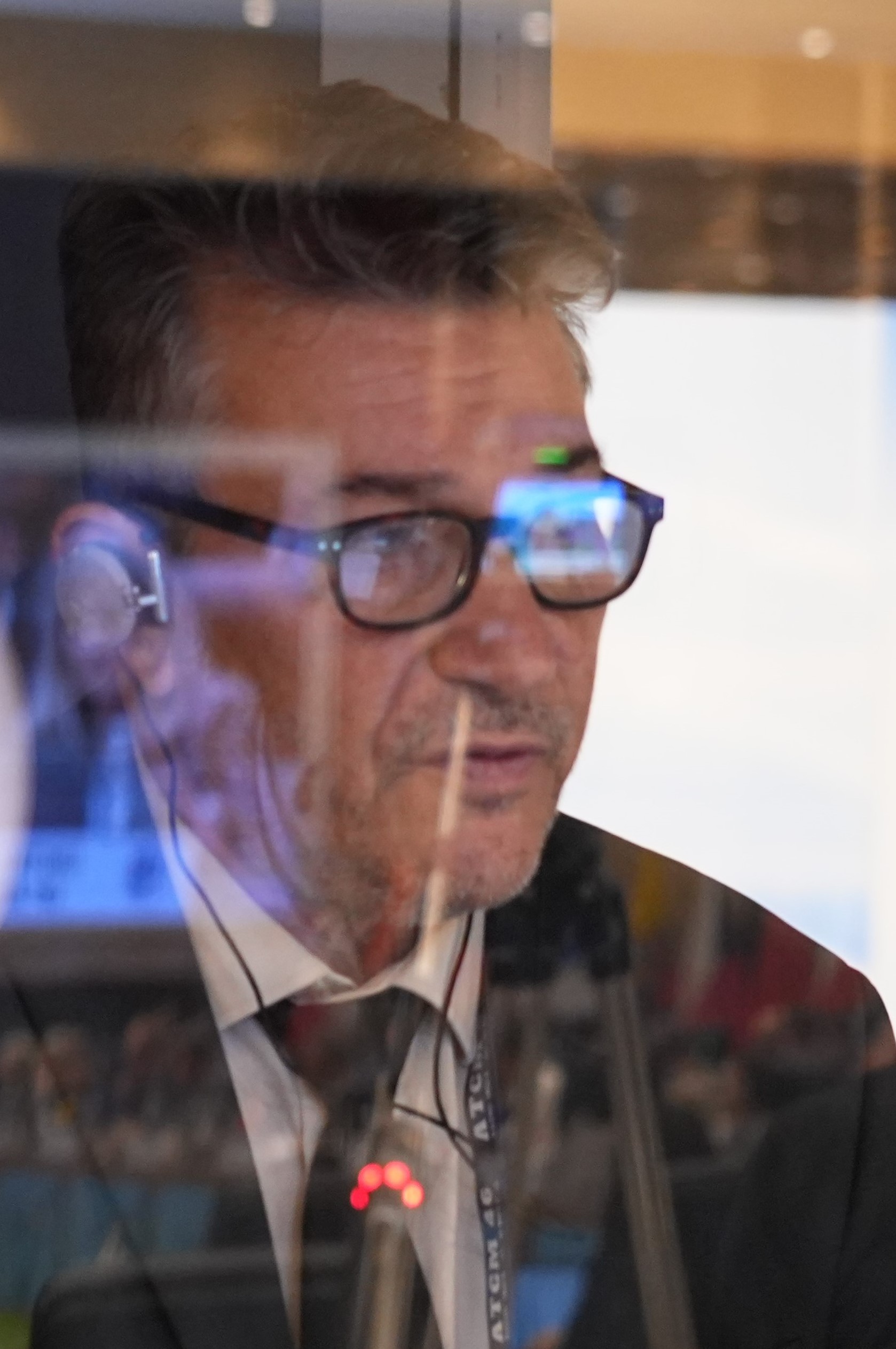
Marc Orlando (PhD) is a Professor and Director of the Translation and Interpreting program at Macquarie University. His research interests are in the training of translators and interpreters and in the synergies between practice, research and training, as well as in the impact of new digital technologies and AI on the T&I professions.
He is also a practicing conference interpreter and is well connected with the T&I industry worldwide, with professional associations, with government departments and multilingual international organisations, with employers and users of T&I services. Such industry engagement provides him with a broad awareness of market needs and trends.